
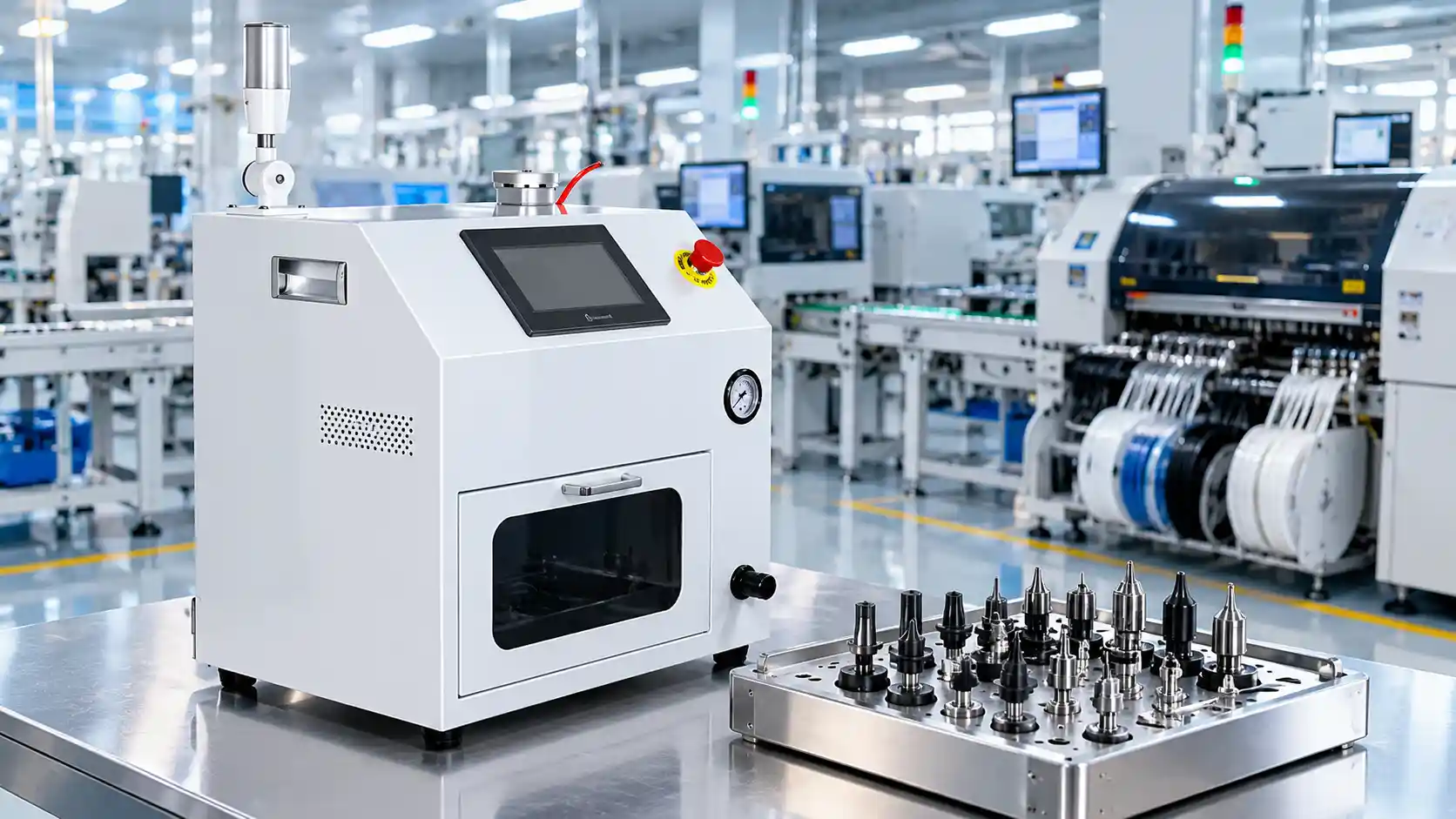
A clogged nozzle does not produce any loud noise. It starts to make mispicks, tilted parts and rework no one can understand. If they occur in an SMT line, they accumulate rapidly. The reliable nozzle cleaning machine ensures that nozzles remain in good condition, maintains pick and place reliability and reduces the number of hours operators must spend on manual cleaning.
However, not all SMT nozzle cleaning machines are appropriate for all factories, due to capacity, compatibility and support differences. This guide will take you through the things to look for before you purchase, so that you can make a production floor investment with your nozzle cleaner.
Why Nozzle Cleaning is important in SMT Production
All pick and place nozzles operate in a vacuum. The tip and inner bore slowly get coated by the fluctuation, solder paste, dust and adhesive residue. Airflow decreases, picks up turns become unreliable, and small parts move and fall while traveling.
Now placement accuracy begins to fall. This drift can be prevented from becoming defects by regular SMT nozzle cleaning. Manual wiping or poking with pins is not a true cure as debris may be left inside or the tip might be scratched.
This is why many lines are now considering pick and place nozzle cleaning to be a scheduled process, rather than emergency repair. This knowledge will make it easier to make a judgment on which features really matter on a machine.
Check Compatibility With Your SMT Nozzles
Don't begin with brochure nozzles, start with your own nozzles. Most factories have a combination of brands and sizes of pick and place machines. List all the nozzle types on your lines before selecting an SMT nozzle cleaning machine. Then ask if all the holders, fixtures or trays in the machine will support all of them. See its size range, shapes and materials it can process. A machine that only fits a handful of models means that your team has to clean the remaining models by hand. Good nozzle cleaning equipment should fit and complement the equipment that you are currently using and allow for future changes of equipment on the shop floor.
Nozzle Size and Type Compatibility
The nozzles can be fine to produce small chip parts and large to produce connectors and odd shaped parts. Ensure that each size can be held in the SMT nozzle cleaner. Request a list of tested makes and models from the supplier as nozzle compatibility is usually only universal if the right adapters are provided.
Material and Surface Protection
The nozzle can be manufactured using metal, ceramic and coated products. Excessive cleaning may result in damage to the tip or damage to the sealing face. An effective nozzle cleaning system will clean the nozzle without damaging the surface. Inquire about the type of nozzle material the supplier has tested with, which will help with long term SMT nozzle maintenance.
Evaluate the Cleaning Method and Performance
The cleaning methods vary by machine, so be sure to carefully study each nozzle cleaning Machine and the actual cleaning it can provide on your line. Check these points:
- If it is ultrasonic, jets, solvents or air pulses
- How the process is delivered into the nozzle bore, rather than the outer tip
- Whether there are any areas of flux, paste and dust that may impact airflow.
- The ability to achieve reduction in operator skill reliance is not substantiated based on the results of the automatic nozzle cleaning machine.
- Testing with your own dirty nozzles and then magnified inspection and vacuum flow check.
- Appropriateness for your production needs, including fine-pitch and mixed jobs
Consistent Cleaning Results
Cleaning once is not enough with a cleaning machine. Repetitive results are required between shifts, batches and operators. When vacuum levels are important, particularly in long production runs, a reliable automatic nozzle cleaner ensures predictable vacuums and eliminates guesswork.
Cleaning Without Damaging Nozzles
Controlled cleaning matters. Tips can be rounded, scratched and become shorter due to excess pressure, aggressive chemicals or poor fixturing. Search for adjustable parameters, and a gentle process that facilitates appropriate nozzle maintenance for many cleaning cycles.
Check Cleaning Cycle Time and Productivity
Time on the line is money. Manual cleaning is a time your team could be using for other tasks. Don't just ask for the nozzle cleaning cycle time, ask for the loading time, cleaning time, rinsing and drying time as well as the cycle time.
For high volume PCB assembly, the rapid cycle will enable teams to easily replace clean nozzles and dispatch dirty nozzles for processing without delaying the line. The right nozzle cleaning machine reduces maintenance downtimes and helps improve SMT production efficiency However, make sure that you don't skimp on quality, as a rushed cycle with residue is a waste.
Consider Cleaning Capacity and Automation Level
The ability and automation determines what line a machine belongs to. There are a number of factors to consider when selecting between small teams and high volume factories, and you should take these into account:
- The number of nozzles that can be cleaned simultaneously.
- Fully automatic or semi-automatic working.
- The load is placed on the machine, e.g. trays, racks or holders
- The suitability of small batch or 24-hour lines.
A suitable automatic nozzle cleaning machine keeps your line moving and a matched SMT cleaning machine increases in size as your production increases. If only one line is involved, a small nozzle cleaner machine might be sufficient.
Consider Operating and Maintenance Requirements
A machine requires attention as well! Cleaning of the unit, consumables, power, compressed air and filter changes are all routine efforts. Check the maintenance program with the supplier before purchasing. Good Nozzle Cleaning Machine maintenance should be something basic that is easy for your own maintenance staff. If it's SMT equipment maintenance, it can result in unplanned equipment stoppages, so make sure utility needs are confirmed early and the facility is able to support the equipment. Simple operator training and instruction manuals also have a big impact.
Consumables and Running Costs
The price of the purchase is just 50% of the equation. Inspect filters, cleaning media, compressed air usage, etc. that occur frequently. Knowing the nozzle cleaner operating cost can help you make accurate budgeting and no unpleasant surprises later when it comes to costing the SMT maintenance.
Ease of Routine Maintenance
Consider reachability to the tank, filters and moving parts. Nozzle cleaning machine maintenance is fast and easy thanks to clear procedures and readily available parts. Simple access also seamlessly integrates into broader SMT machine maintenance workflows.
Ensure Safety and Ease of Operation
The actual value of a machine is found in its use over a period of time. The controls should be easy to understand for operators, loading and unloading should be easy.
Encapsulated cleaning chambers reduce splash, vapour and noise and contribute to a safer workspace. Clear indicators and one touch programs minimize errors with door interlocks.
An effective SMT Nozzle Cleaning Machine should require little training. For shift-based factories, an automatic nozzle cleaner with intelligent protection is more suitable, and for factories with a lot of use, a durable industrial nozzle cleaner can be easily put into use.
Compare Supplier Support and After-Sales Service
The machine is just half the price. The remainder is made up of support. In the selection of nozzle cleaning machine suppliers, don't focus only on cost. Discuss technical advice at selection, installation assistance and availability and service response time.
A good SMT equipment supplier such as IMTronics will know what pick and place processes are, and will be able to tell you how the SMT machine will fit your line. If available, request references from other factories of a similar nature.
A responsive nozzle cleaning machine supplier cuts down time, because any saving they make on the purchase will be lost if the equipment is out of service due to late spares or late for service.
Questions to Ask Before Finalizing a Nozzle Cleaning Machine
This is a brief checklist to keep with you when discussing suppliers. It simplifies your decision making process in a fair and equitable way, and eliminates any costly surprises after you purchase:
- Is there a variety of nozzle sizes and types that it supports?
- How many nozzles can it be used to clean in one cycle?
- How does it clean and could I watch a trial of it?
- What is its required air and consumables?
- Is it easy to purchase spares?
- Which support for installation and service is provided?
Clear answers can help you confidently buy nozzle cleaning machine equipment and make your nozzle cleaning machine selection with fewer doubts.
Conclusion
Compatibility, cleaning performance, cycle time, capacity, running costs, ease of use and dependable support are all factors to consider when selecting the appropriate Nozzle Cleaning Machine. Consider each factor in light of your own production requirement. For a reliable SMT nozzle cleaning machine, check out IMTronics' nozzle cleaning machine and discover how it contributes to cleaner nozzles, consistent placement, and smoother production.
|
Contact the IMTronics team today to learn more about our Nozzle Cleaning Machine and get a quote to suit your production requirements. |
Frequently Asked Questions
Residue like flux, solder paste and dust blocks airflow and weakens vacuum pickup. Regular cleaning prevents missed picks and placement errors, keeping your line stable and reducing rework.
List the nozzle sizes, shapes and materials used on your lines. Then confirm that the machine’s holders and fixtures support all of them without damaging the tips.
Check whether the process reaches the nozzle bore and removes residue from every airflow surface. Ask for a trial with your own dirty nozzles and inspect the results under magnification.
Yes, especially in high-volume PCB assembly. A shorter cycle, including loading, cleaning and drying, reduces maintenance downtime and supports better production efficiency.
Recurring costs include filters, cleaning media and compressed air usage. Checking these before purchase helps you budget accurately and avoid surprises later.
Look for technical guidance, installation support, spare availability and quick service response. Strong support keeps downtime low and protects your investment over time.