
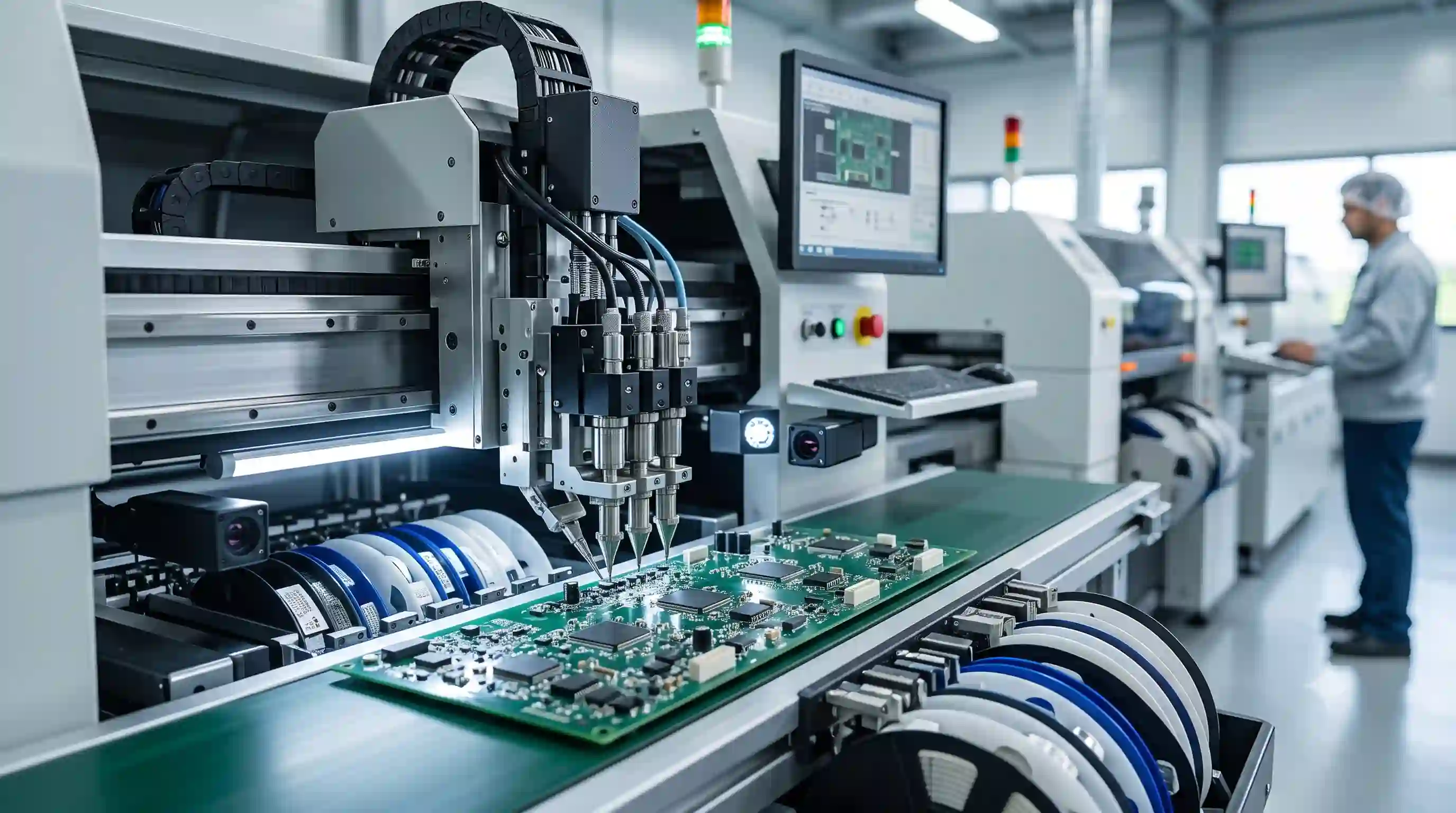
A practical buyer's guide to evaluating SMT equipment partners for consistent PCB assembly performance.
Picking a partner from the many pick and place machine manufacturers on the market changes far more than a purchase order — it decides how steady placement accuracy stays a year on and how often a line waits idle for a fix. Demand for trustworthy pick and place machine manufacturers in India has grown fast as assembly units scale up output. We watched the pattern repeat: a rushed pick almost always resurfaces later as rework or downtime.
What Is a Pick and Place Machine?
Some groundwork first, since the buying decision only makes sense once the machine's job is clear.
A pick and place machine lifts electronic components from reels or trays and sets them onto a PCB at the precise spot a design specifies. Get the alignment even slightly off, and the whole board risks rework. Mid-to-high volume assembly lines lean on some form of SMT pick and place machine today; manual placement simply can't match the speed or the repeatability these production schedules now demand.
Why Choosing the Right Manufacturer Matters
Two machines with identical spec sheets can behave completely differently once installed — the difference sits with the manufacturer.
Build quality from the pick and place machine manufacturer decides how long placement heads hold calibration. Software design decides how fast an operator switches jobs. And the manufacturer's after-sales response decides whether a breakdown costs an hour or a week. Pick an SMT machine manufacturer with thin support, and a small fault turns into a real bottleneck fast — which is exactly why this deserves more than a five-minute price check.
Key Factors to Check Before Choosing a Manufacturer
What actually separates reliable pick and place machine manufacturers from the rest comes down to five checkpoints.
Trust in a pick and place machine supplier comes down to accuracy, compatibility, automation, support, and spare-part access. Each affects daily output on its own terms, so weigh them one at a time instead of forming a single overall impression.
Machine Accuracy and Placement Speed
Numbers on a spec sheet are the first thing a production team notices.
- Placement accuracy against your actual component sizes matters more than the number printed on a brochure.
- Does a high speed pick and place machine hold its rated speed under a real component mix, or only in a demo run?
- Repeatability, not raw speed alone, keeps PCB quality consistent run after run.
- Ask existing customers for verified SMT placement machine cycle-time data before taking a vendor's word for it.
Supported Component and PCB Types
Speed counts for little if the machine can't process what actually comes down the line.
- Feeder compatibility across your full component range — from 0201 chips to bulkier connectors — needs confirming upfront.
- Will a PCB pick and place machine handle your board-size range without constant reconfiguration between runs?
- Mixed-technology boards are common on many lines; check whether the SMT pick and place equipment actually supports them.
- Board dimensions worth checking against today's designs, and against whatever comes next.
Automation and Software Features
How the machine handles day-to-day operation matters as much as raw capability.
- Do vision alignment systems come standard, or as a costly add-on?
- Programming shouldn't demand a steep learning curve — an automatic pick and place machine worth buying keeps job setup simple.
- Recalibration eats shift time; automatic calibration claws that time back.
- Built-in inspection on SMT automation equipment catches defects before boards move further down the line.
Installation and Technical Support
Support quality reveals itself only after the invoice is settled.
- What installation assistance comes included, and does operator training ride along with it?
- Local troubleshooting beats a remote call every time; a solid pick and place machine supplier in India offers both.
- Get service response windows in writing — not discovered mid-breakdown.
- A real track record of on-site visits says more about an SMT equipment supplier than any brochure claim.
Keeping Spare Parts and Maintenance Within Reach
One thing decides most of the downtime bill: how quickly the machine gets back on its feet.
- Local stock of common pick and place machine spare parts saves the wait that comes with an overseas shipment.
- A preventive maintenance calendar does more for uptime than most operators expect.
- In-house, on-site, or remote diagnostics first — find out how SMT machine maintenance actually gets handled.
|
DID YOU KNOW? “Component counts on a modern high speed pick and place machine can run into the tens of thousands per hour — a pace manual placement was never built for.” |
Manual vs. Automatic: A Quick Placement Comparison
Here's how the two stack up, factor by factor.
| Factor | Manual Placement | Automatic Pick and Place Machine |
|---|---|---|
| Speed | Tied to operator fatigue and skill | Holds high throughput across long shifts |
| Accuracy | Shifts with fatigue and component size | Stays consistent, vision-guided |
| Labor Dependency | High; output tracks headcount directly | Low; one operator can oversee a line |
| Best For | Small batches and prototype runs | Steady, higher-volume PCB output |
|
FACT: “Placement tolerances on these machines run in microns — nothing the eye could ever catch, yet that margin decides whether a solder joint survives real-world vibration and heat.” |
Questions to Ask Pick and Place Machine Manufacturers
A short list of direct questions can save months of frustration later.
- What's the realistic production capacity per hour, tested with typical component mixes?
- How is placement accuracy verified, and is that data available for review?
- What do the warranty terms actually cover, beyond the headline duration?
- Which software comes standard, and how steep is the learning curve for new operators?
- Are feeders a part of the deal, or purchased separately per component?
- What arrangements are there for servicing after the expiry of the warranty period?
- How readily are replacement parts available, and are frequently used parts kept locally?
- Is customization possible for individual PCB or components?
Why Indian Electronics Manufacturers Need Reliable SMT Equipment Partners
What counts as reliable shifts once local realities enter the picture.
Electronics manufacturing in India runs on tighter timelines than many buyers plan for, so local presence isn't optional. A distant SMT equipment supplier in India without a regional service team can turn a small fault into days of lost output.
IMTronics Technology works from an understanding of local component sourcing, power conditions, and factory floors — context that keeps equipment closer to spec over time. Demand for electronics manufacturing equipment keeps climbing across EMS units and PCB lines, and a partner who shows up quickly on the ground outweighs a marginally cheaper quote.
|
TRIVIA: “Early pick and place machines from the 1960s were slower than skilled human hands. Automation only pulled ahead once vision systems became sharp enough for fine-pitch work.” |
Conclusion
A handful of principles carries the whole decision.
Price alone shouldn't decide a pick among pick and place machine manufacturers. Accuracy, compatibility, support, and spare-part access compound across a machine's working life far more than any brochure claim. Weighing pick and place machine India options? IMTronics Technology pairs dependable SMT equipment with responsive local support — a combination worth a closer look before any purchase is finalized.
Frequently Asked Questions
Check placement accuracy under real component loads first. Confirm feeder and PCB compatibility, then review the software and automation on offer. Installation support and response times deserve direct questions too. Read the fine print on warranty coverage; it usually tells you more about long-term reliability than the sticker price.
Does the machine handle your current component range and PCB sizes without constant reconfiguration? That's worth confirming first. Placement accuracy specs should match your expected volume, feeder compatibility needs checking, and realistic hourly capacity matters more than a headline number. Software ease of use shapes daily efficiency too.
The accuracy of placement determines if the parts can be placed correctly as per the design of the PCB, and that affects the quality of the solder joints. Lack of accuracy implies additional processing time and wastage of materials. Accuracy is very important over a long production process.
Three features now count as standard, not premium: vision alignment, automatic calibration, and built-in inspection. Together they cut manual work, catch errors early, and shorten changeover between PCB jobs. Skip these, and operators carry more of the workload — slowing production and letting defects slip through.
Downtime is the cost. Local support decides how fast a fault gets fixed before it turns into days of lost production. Manufacturers without a regional service team leave factories waiting on a technician or a part. Local installation, training, and troubleshooting keep output near rated capacity and lower ownership cost.
With IMTronics Technology, customers get the advantage of good design coupled with prompt local service throughout India. This will ensure fast response to any break-downs and also help in maintaining high levels of production.