
A no-nonsense guide to choosing rework equipment that actually holds up on the line.
Getting a rework station decision right saves more than money — it protects boards from costly failures later. PCBs keep getting denser, and a plain soldering iron can't keep pace anymore. Pick the wrong rework station for electronics, and scorched pads and slower turnaround follow. Pick well, and repair stays fast and safe for delicate parts.
This blog covers the types, features, and buying checkpoints that matter most on a real production line.
First, the basics.
What Is a Rework Station?
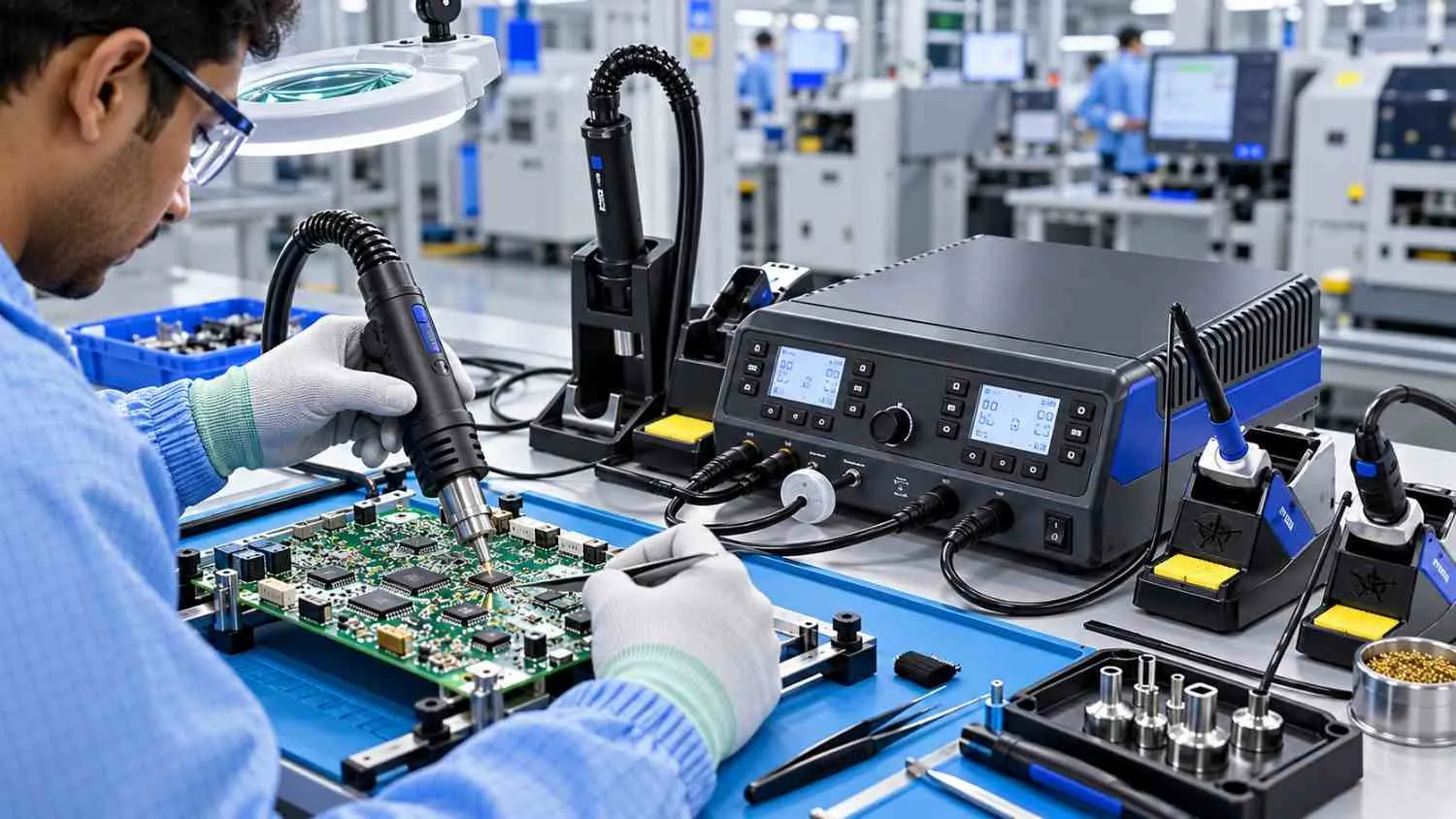
What separates a rework station from an ordinary soldering iron? Function, mostly. The iron provides the heat source at one stationary point; however, the soldering rework station provides all three – heat, air flow control, and temperature control in one device. This way, technicians have an easy time removing and replacing parts. Several PCB rework station models add hot-air handpieces too, built for chip-scale packages a tip can't reach.
Now, here's why it counts on the floor.
Why Rework Stations Are Important in Electronics Manufacturing
Defects happen on every PCB line — a misplaced chip, a cold joint, a component that fails testing. Skip proper rework station for electronics equipment, and boards often get scrapped outright. Electronics rework equipment lets technicians correct defects, swap failed parts, and rescue prototypes headed for the bin, plus handle fielded maintenance. Reliable PCB repair equipment cuts waste and keeps schedules intact.
Type comes first, though.
Types of Rework Stations Used in Electronics Manufacturing
No single configuration suits every job. What works depends on component type, PCB complexity, and how often repairs come up. Three broad categories cover most manufacturing needs — the same ones IMTronics Technology supplies across its SMT and rework equipment range.
Hot Air Rework Station
Think controlled airflow, not direct contact. A hot air rework station heats components evenly through directed air, suited to SMD removal — including fine-pitch ICs a soldering iron risks damaging. Airflow and temperature adjust independently, so heat delivery matches each component's size and sensitivity.
Soldering and Rework Station
Some benches need both tools at once. A soldering and rework station merges a conventional iron with a hot-air handpiece, suited to work swinging between through-hole soldering and SMD rework in one shift. Fewer tools, less switching — a real advantage on mixed-board lines.
Advanced PCB and SMD Rework Systems
What about dense, multilayer boards? Advanced systems bring preheating plates, vision alignment, and finer temperature profiling into play. A PCB rework station at this tier handles BGA packages where a small thermal miscalculation risks the whole assembly. Costs run higher, and so does the precision payoff.
See how they stack up:
| Feature | Hot Air Rework Station | Soldering and Rework Station | Advanced PCB/SMD Rework System |
|---|---|---|---|
| Heating Method | Controlled airflow | Iron + hot-air combo | Airflow + preheat plate |
| Best Suited For | Fine-pitch SMD and IC work | Mixed through-hole and SMD repair benches | Dense multilayer and BGA boards |
| Typical Setting | Dedicated SMD repair stations | General-purpose repair benches | High-precision production repair labs |
| Investment Level | Moderate | Moderate | Higher |
|
TRIVIA: “1980s rework stations relied on basic resistive heat guns with almost no temperature control. Today's units hold heat within a few degrees Celsius.” |
Features decide the rest.
Key Features to Check Before Buying a Rework Station
Price tells you little about whether a station survives a busy bench. The details below decide repair quality and how long equipment lasts — far more than the sticker price will.
Temperature Control and Stability
Look for stability, not just a number. A temperature-controlled rework station should hold its set value steadily through extended use, since alloys and substrates respond differently to heat. Closed-loop feedback protects against lifted pads far better than basic dial-only heating.
Airflow Control
Does one airflow setting fit every job? Rarely. A large connector needs broad, gentle airflow; a tiny resistor needs a narrow stream. A capable hot air rework station offers independent adjustment, so technicians aren't stuck using one setting for every repair.
Power and Heating Performance
Heat recovery speed matters more than people expect. Wattage decides how fast a station reaches working temperature and recovers between jobs — weak recovery slows a busy line down. A professional rework station should bounce back almost instantly.
ESD Safety and Component Protection
Static damage doesn't announce itself. A single discharge can silently harm components, surfacing only after the product ships. An ESD-safe rework station, paired with grounded mats and wrist straps, closes that gap — a requirement for serious PCB repair equipment buyers.
Nozzle and Tip Compatibility
Check the nozzle variety before you buy. Repair spans fine-pitch ICs to larger connectors, so a good soldering rework station needs interchangeable accessories sized to different footprints — one nozzle can't handle every job.
|
DID YOU KNOW? “A pad overheated by just 20-30°C beyond its rated limit can delaminate invisibly, only failing weeks after assembly.” |
How to Choose the Right Rework Station for Your Application
Choosing a rework station for electronics starts with your actual production, not a spec sheet. PCB type, component density, repair frequency, and operator skill shape what makes sense — a prototyping lab and a high-volume line rarely need the same machine.
Checkpoints worth running through:
- Match PCB complexity to capability — dense boards need finer control.
- How often will repairs actually happen? Different duty cycles suit different workloads.
- Simpler interfaces mean less training time for new technicians.
- Don't chase the lowest price. A professional rework station that runs consistently saves more long-term.
- Production volume, checked upfront — undersized equipment gets pushed past its limits.
Common Applications of Rework Stations
PCB rework station equipment earns its place across almost every production floor.
Where it gets used most:
- SMD removal and reinstallation
- Correcting cold or bridged solder joints
- IC swaps during testing
- New component installs mid-prototype
- Repeated PCB rework through design iterations
- Field and line repair — covers rework station for PCB repair needs
|
FACT: “One unresolved cold solder joint can cause intermittent failures far trickier to diagnose than a component that fails outright.” |
Mistakes to Avoid When Buying a Rework Station
Most buying regrets trace back to the same handful of errors.
Avoid these before you sign off:
- Picking by price alone, ignoring temperature stability
- Underpowered stations struggle once board variety shows up
- Skip spare nozzles and tips, and downtime follows
- ESD safety gets overlooked on budget units too often
- After-sales support isn't guaranteed — check first
Support is the part people forget.
Why Equipment Quality and Supplier Support Matter
Good equipment is only half the story. Ongoing support, spare parts, and consumables keep a rework station running for years, not months. IMTronics Technology works directly with manufacturers on equipment selection, genuine consumables, and servicing that keeps downtime minimal. As a rework station supplier, delivering the machine is just the start.
Sourcing electronics manufacturing equipment? Check a supplier's service record as closely as the spec sheet. IMTronics Technology's range at imtronics.in is built around this.
Decision time.
Conclusion
The choice of rework station involves considerations more important than the cost factor, such as temperature control, airflow accuracy, heat capacity, ESD protection, nozzle adaptability, and excellent post-sales service. Consider these rather than the cheapest offer when choosing your machine.
The selection of the right PCB rework station ensures protection for the components, reduced wastage, and efficiency of the repair process. IMTronics Technology builds its range around exactly these priorities.
|
Ready to upgrade? Talk to IMTronics Technology about the right rework station for your line. |