
Why Getting Solder Paste Right Matters More Than You'd Think
Ever printed a board and wondered why the joints looked... off? Nine times out of ten, it's the paste. A Solder Paste Mixer fixes exactly that problem — it restores consistency after the paste sits in cold storage, so flux and metal particles don't separate on your mid-shift. Good electronics manufacturing comes down to small steps like this one, and paste prep is easy to overlook until it costs you a batch. Skip proper mixing, and defects follow, plain and simple. This blog gets into why a solder paste mixer matters so much for smooth, dependable SMT production.
What Is a Solder Paste Mixer?
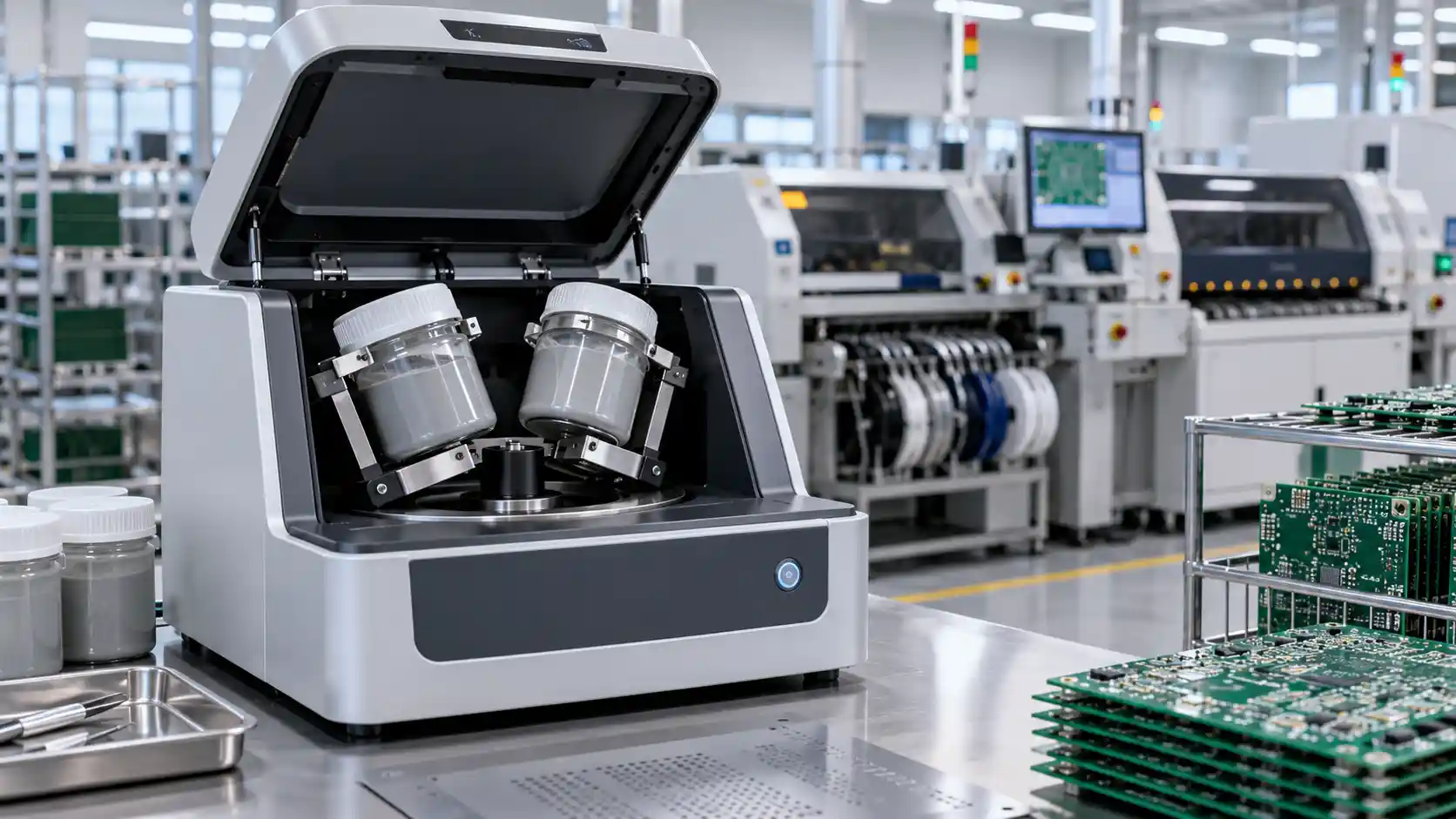
So what exactly is a solder paste mixer? Simply put, its SMT equipment is built to bring solder paste back to its proper texture and viscosity before stencil printing. Here's the thing — paste doesn't sit still in storage. Metal particles sink, flux rises to the top, and left alone, that separation ruins your print. A SMT solder paste mixer solves this through controlled rotation, blending everything back together evenly. No guesswork. No uneven stirring by hand.
- Brings paste back to a smooth, even consistency
- Clears out air pockets that build up in storage
- Gets paste ready for clean, accurate stencil printing
- Cuts down on manual stirring — inconsistent at best
|
Did You Know? Paste can lose its ideal working consistency within a few hours of leaving cold storage. That's not an exaggeration — it's exactly why mixing isn't optional. |
Why Solder Paste Mixing Is Important in PCB Assembly
Here's where things go wrong on a lot of lines: paste comes straight out of the fridge, gets loaded, and nobody thinks twice about solder paste preparation. Big mistake. Improper PCB assembly prep shows up fast, usually as printing issues nobody wants to deal with mid-shift.
- Poor stencil printing from paste that won't flow right
- Solder deposits landing unevenly across pads
- Bridging between components sitting close together
- Weak joints that don't hold up after reflow
- More boards flagged at inspection, more rework, more time lost
None of this is rare. It's what happens when soldering defects trace back to paste. Nobody bothered to mix properly before running the line.
How Does a Solder Paste Mixer Work?
A solder paste mixing machine doesn't do anything fancy — it rotates the container at a controlled, low speed, folding flux and metal particles back together without overheating the paste or trapping air in it. The motion covers the whole container evenly, unlike a hand stirring one corner and missing the rest. Most machines let you dial in speed and time based on how much paste you're working with.
- Controlled rotation blends everything evenly, no shortcuts
- Speed and timer settings adjust to different paste types
- Even distribution means no over-mixing, no trapped air
- Keeps viscosity steady through an entire shift
|
Trivia Automated paste conditioning has been around for decades now. Yet plenty of smaller assembly shops still stir by hand — usually the first thing to blame when print quality goes sideways. |
Key Benefits of Using a Solder Paste Mixer in Electronics Manufacturing
The payoff from a solder paste mixer isn't limited to one print run — it ripples through the whole electronics manufacturing line. Cleaner stencil prints, fewer rejects, steadier output. Worth paying attention to.
- Sharper, more consistent print quality
- Fewer defects, less rework eating into your schedule
- Better throughput across the line
- Less wasted paste from poor mixing
- Predictable results, run after run
Improves Solder Paste Consistency
A mixer brings solder paste viscosity back to where it should be, so it flows smoothly during printing. That keeps solder paste consistency steady across a long run — board one looks like board five hundred.
Reduces PCB Assembly Defects
Mixed properly, paste causes fewer PCB defects — bridging, voiding, the usual suspects. It supports better SMT production quality and means fewer joints failing when they hit final inspection.
Enhances Production Efficiency
An automatic solder paste mixer saves setup time and takes manual prep out of the equation. Operators get consistent SMT efficiency shift after shift, without babysitting the process.
Manual Mixing vs. Automatic Solder Paste Mixer
| Parameter | Manual Mixing | Automatic Solder Paste Mixer |
|---|---|---|
| Consistency | Depends on the operator | Uniform, every single cycle |
| Time Required | Slower, hands-on effort | Fast, timer-controlled |
| Air Entrapment | A common risk | Kept to a minimum |
| Print Quality Impact | Hit or miss | Reliable, repeatable |
| Operator Dependency | High | Low |
Applications of Solder Paste Mixer in Different Industries
A solid solder paste mixer isn't tied to one type of production. Solder paste mixer applications show up all across the electronics industry wherever SMT assembly needs to hold up to real standards.
- Electronics manufacturing and contract assembly units
- Automotive electronics and control module production
- Telecom equipment and networking hardware assembly
- LED and lighting component manufacturing
- Medical device electronics — where reliability isn't negotiable
- Industrial automation and control panel assembly
Factors to Consider Before Choosing a Solder Paste Mixer
Picking equipment from a solder paste mixer supplier — or a solder paste mixer manufacturer India like IMTronics— comes down to more than the price tag. A few things actually matter long-term.
- Mixing capacity suited to your production volume
- Precise speed control for different paste types
- Adjustable timer settings for repeatable results
- Compatibility with the jar sizes used on your line
- Built-in safety features for continuous operation
- Proven reliability, backed by real after-sales support
|
Fact Boards printed from inconsistently mixed paste fail automated optical inspection more often on the first pass. That's an avoidable cost, plain and simple. |
Why Choose IMTronics for Solder Paste Mixer Solutions?
IMTronics knows SMT — that's not just a tagline, it shows in the equipment. Walk through their build process and it's obvious: welded frames, calibrated motors, jar mounts sized for standard cartridges instead of forcing an adapter on you. As a Solder Paste Mixer Manufacturer in India, they build machines meant for actual production floors, not just spec sheets — and that shows up in how a machine performs after month six, not just on day one.
Ask any line supervisor what actually breaks trust in a supplier, and downtime tops the list every time. IMTronics Technology backs its equipment with real technical support — not a call center reading a script, but people who understand SMT lines and can troubleshoot fast when a shift is on the clock. Working with a dependable SMT equipment supplier means fewer surprises: consistent builds, responsive service, machines that hold up across contract assembly shops and high-volume automotive lines alike.
Choose IMTronics, and it's not just a mixer you're buying — it's a support relationship that keeps the line running.
Conclusion: Improve SMT Performance with the Right Solder Paste Mixer
A Solder Paste Mixer looks like a small piece of kit, but its impact isn't small at all. Better viscosity, fewer defects, steadier output — it sets up everything downstream. If your line depends on dependable SMT equipment, treat paste conditioning like it matters. Because every solder joint that follows depends on it.
Frequently Asked Questions
Its job is simple: bring solder paste back to the right texture before printing. During cold storage, flux and metal particles drift apart — a mixer blends them back together through controlled rotation. Get that step right, and the paste flows evenly, printing comes out clean, and solder joints hold up the way they should.
Solder paste is basically metal particles suspended in flux — and gravity doesn't care about your production schedule. In the fridge, heavier particles sink while flux floats up. Skip the remix, and you're looking at uneven viscosity, patchy printing, and defects that trace right back to paste nobody bothered to mix.
Depends on the batch, honestly. Volume, viscosity, machine settings — they all play a part, so mixing can run anywhere from a couple of minutes to a bit longer for bigger loads. Most automatic mixers let you set the exact time and speed, so you get consistent paste without over-mixing and trapping air in it.
Technically, yes. Practically? Not really. Manual stirring lives and dies by operator technique, and it's easy to leave patches of paste under-mixed without realizing it. An automatic mixer rotates the whole container evenly, giving you the same consistency every single time — something hand-stirring just can't keep up with on a busy line.
More than you'd expect. Automotive electronics, telecom hardware, LED manufacturing, medical devices, industrial automation — anywhere SMT assembly runs, a mixer earns its keep. Reliable solder joints matter just as much in a high-volume consumer line as they do in a low-volume, high-stakes one. Consistent paste prep doesn't discriminate by industry.
A few things actually matter here: mixing capacity that fits your volume, speed and timer controls you can adjust, compatibility with the jar sizes you already use, and solid safety features. Beyond that, go with an established manufacturer — after-sales support makes a real difference once the machine's been running for a while.