
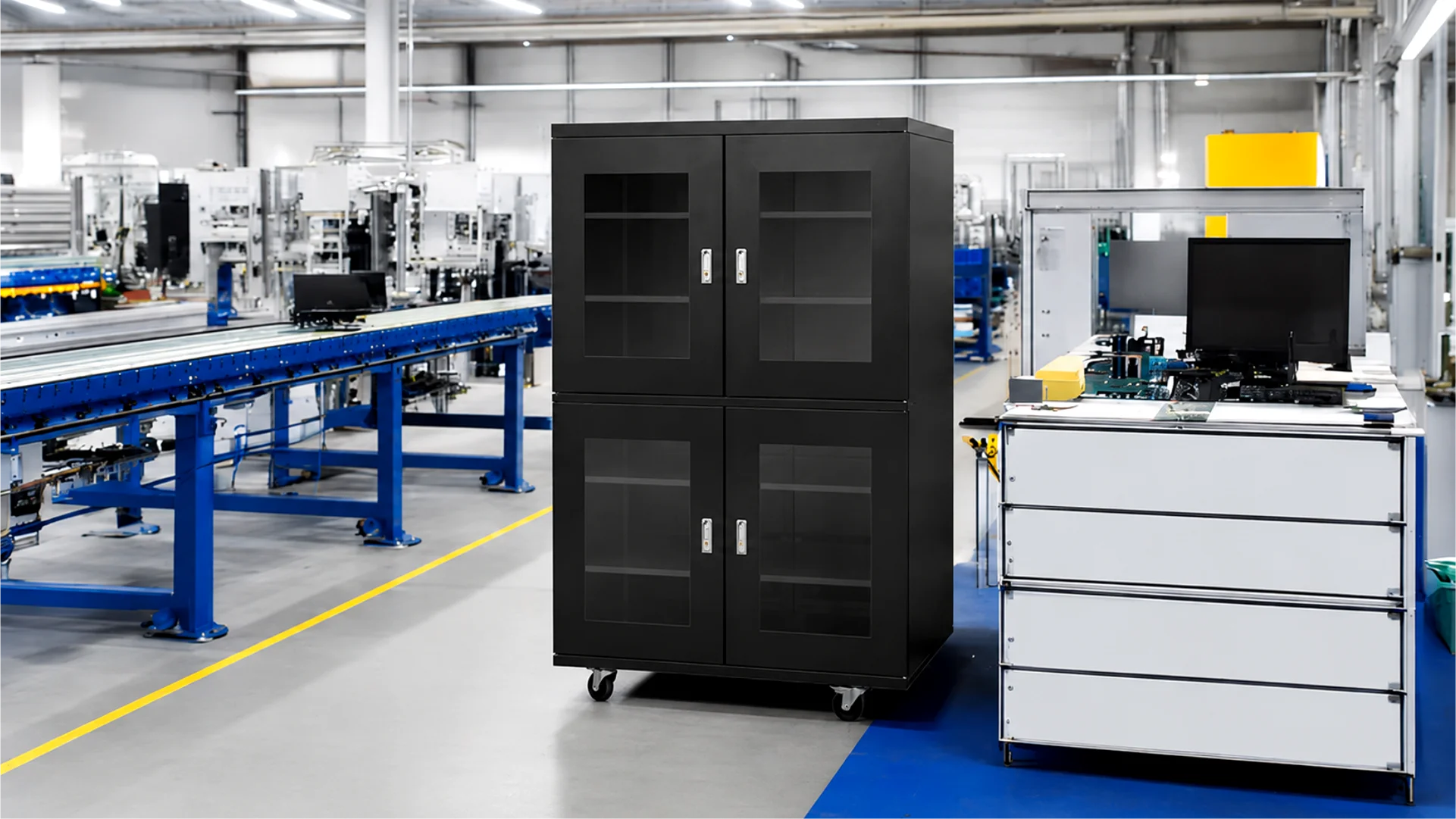
Every electronics engineer, photographer, and manufacturing engineer knows the feeling: a perfectly functional component, lens or PCB assembly - damaged not by a blow or accidental use, but by the invisible humidity in the air. Humidity damage and rust are among the most avoidable sources of equipment damage in the world. But thousands of rupees' worth of camera equipment, electronics, and other industrial equipment are ruined each year because they were improperly stored.
electronic dry cabinets for sensitive ICs and PCBs, to dry cabinets for delicate camera lenses and camera bodies, to industrial humidity control dry cabinets for your manufacturing plant, we've got you covered with all the information you need on types, features, best brands, and the dry cabinet price in India for 2026.
What is a Dry Cabinet and Why Does It Matter?
A humidity-controlled dry cabinet is an enclosed cabinet that keeps the relative humidity (RH) level inside low - typically 35-50% RH for general electronics, and 40-50% RH for camera equipment. A dry storage cabinet is different from conventional cupboards or boxes as it actively removes moisture from the storage environment using integral dehumidifying technology.
Why humidity is the enemy of electronics:
Air humidity causes electrochemical oxidation of metal contacts, printed circuit board (PCB) traces and connector pins. Oxidation results in higher electrical resistance, intermittent shorts and ultimately circuit failure. For optical lenses (such as camera lenses), moisture encourages fungal growth, a slowly spreading contamination that permanently scars glass surfaces and erodes coating layers.
For components like sensors, relays, motor controllers, and semiconductor modules stored in a warehouse or stockroom with variable temperature, humidity cycling (warm/cold daily cycles) is especially harmful. It creates a cycle of condensation on the surfaces of components, accelerating corrosion much more than in areas of constant humidity.
A dry cabinet with dehumidification prevents this cycle by keeping humidity levels constant and low at all times, independent of outdoor and indoor conditions.
How a Dry Cabinet Works
The two most common forms of dehumidification in modern dry cabinets are:
Thermoelectric (Peltier) Dehumidification: The most common type used in consumer and prosumer dry cabinets. Moisture condenses on a cold surface inside the cabinet and is drained away via a Peltier element. Noiseless, efficient, and low maintenance. Average power: 3-8 watts. It's the default technology in digital dry cabinets in India.
Desiccant Dehumidification: Uses silica gel or molecular sieve desiccant material. These can be regenerating desiccant cartridges that are heated to release absorbed moisture. Ideal for very low humidity levels (below 35% RH) or in a very humid environment.
Electronic Humidity Control: High-end digital dry cabinets have a digital hygrometer and humidity controller. The controller will turn the dehumidifying element on and off to achieve the desired humidity level ±5% RH. This is important for accurate storage where the desired RH is crucial (e.g. 40-45% RH for camera bodies, 35-40% RH for bare semiconductors).
Types of Dry Cabinets: Which One Do You Need?
Electronic Dry Cabinet
Ideal for storing printed circuit boards, semiconductors, IC, SMD components, sensors, relays, and other sensitive electronics. Electronic dry cabinets typically have RH levels between 35% and 50%. They usually have anti-static shelving to protect against ESD damage in addition to moisture protection.
Ideal for: Electronics manufacturers, repair services, PCB assembly, research & development, parts storage.
Available sizes in India: 20 - 500+ litres.
Dry Cabinet for Camera
Camera equipment (DSLR and mirrorless bodies, interchangeable lenses, telescopes, binoculars, film stock) is highly susceptible to fungus in India's wet environment. The relative humidity (RH) in a dry cabinet for a camera is typically maintained at 40-50%, an international standard for storing optical equipment (too dry and the lubricants in the camera lenses dry out; too wet and fungus grows).
The top dry cabinet for a camera in India will typically be 22 litres (fits 1-2 camera bodies and 3-4 lenses), up to 100+ litres for studio equipment. Opt for clear doors (for easy viewing), adjustable shelves (to store zoom lenses) and ±5% RH accuracy.
Dry Cabinet (General Industrial)
Sturdy, rugged industrial models. Ideal for storing tooling, measuring instruments, metal components, moulds, and moisture-sensitive products such as adhesives and moisture-absorbing polymers. Typically, powder-coated steel construction and heavy-duty shelves.
Dehumidifying Dry Cabinet (High-Performance)
Designed for extremely low RH levels - as low as 10-20% RH - in critical applications. Commonly found in semiconductor process equipment, pharmaceutical storage, and optics. Dry cabinets typically employ desiccant wheel technology and can be much more costly than standard thermoelectric dry cabinets.
Humidity Control Dry Cabinet (Smart Models)
The newest smart dry cabinets are WiFi connected, with humidity and temperature monitoring through a mobile phone app, an instrument logger (tracks humidity and temperature history) and set schedules. Certain models can send notifications if humidity levels stray from the desired range - a critical feature for industrial humidity control when dry cabinets are left unattended. These are the top-end digital dry cabinet models.
Dry Cabinet for Camera: India's Biggest Use Case
Camera dry cabinets are essential in India's climate. Humidity levels in Mumbai, Chennai, Kolkata, and coastal areas during the monsoon are between 70-95%. These conditions can lead to lens fungus in unprotected camera equipment stored for even a short period of time - a permanent and irreversible condition requiring professional cleaning.
How to tell if your camera equipment has fungus: Milky patches on lens elements, thread-like growth in the lens barrel, lower contrast and flare in photos, and permanent etching of lens coatings in circular shapes.
Optimal humidity for storing cameras: 40-50% RH This will prevent fungal growth (requires RH above 60%) and maintain internal lubricants and sealant conditions (below 35% RH can cause seals to dry and crack with time).
What size dry cabinet for a camera do you need?
A cabinet with a volume of 22 to 30 litres has enough room for at least one or two cameras, and for four to six lenses. A cabinet with a volume of 40 to 60 litres can store a whole amateur or semi-professional camera kit (telephoto lenses included). Photographers and videographers who have an enormous amount of equipment will benefit from cabinets that have volumes of 80 to 120 litres.
Manufacturers of the best camera dry cabinets in India include Eureka Dry Tech, Eirmai, Forsafe, and Bosch; the prices for camera dry cabinets range from ₹3500 to ₹25000, depending on size and features.
Dry Cabinet Price in India (2026 Guide)
When considering a dry cabinet price in India, it is important to consider capacity, features, and brand. Here's a detailed breakdown:
Entry Level — up to ₹2,000 to ₹5,000: Capacity: 10–30 litres. Basic thermoelectric dehumidification. Semi-automatic or manual humidity control. Ideal for a small camera bag or an electronics enthusiast's laboratory. Examples of brands are low-cost imports or nameless products from online retailers. Quality is not the best.
Mid Range — up to ₹5,000 to ₹12,000: Capacity: 30–80 litres. Electronic humidity and digital display. ±5% RH accuracy. Adjustable shelves, clear glass door. Recommended for professional photographers, electronics tinkerers and repair shops. The most popular price range for a camera dry cabinet in India. Brands: Eirmai, Forsafe, Eureka Dry Tech, lower end.
Professional — up to ₹12,000 to ₹30,000: Capacity: 80–200 litres. Electronic humidity control, more accurate sensors, superior seals. Data logging available. Used by professional photographers for quality control of electronic manufacturing and for storing medical devices. Eureka Dry Tech, Bosch, and imported Japanese.
Industrial / Enterprise — up to ₹30,000 to ₹2,00,000+: Capacity: 200 litres to several cubic metres. Industrial-grade (waterproof) construction, very low RH (10-35%), multi-chambered, nitrogen purging (in high-end models), complete data logging and remote monitoring. Applications include semiconductor manufacturing, support to pharmaceutical cold storage, and aerospace component storage.
The electronic dry cabinet price (for component storage) is typically a bit more than a camera dry cabinet of similar size due to anti-static shelving and tighter RH control.
Key Features to Look for When Buying a Dry Cabinet
LCD Digital Hygrometer: A digital dry cabinet should have an LCD or LED display of the internal humidity. Analogue gauges are not accurate enough. ±3-5% RH accuracy is required.
RH set-point: You should be able to control the RH (not just turn it on or off). The optimal range for camera equipment is 40-50% RH. Electronics need 35-45% RH. A humidity control dry cabinet that allows you to set the desired level is better than one with set points.
Door Quality: The seal on the door is the barrier between the inside and out. Try to open the door; it should be sealed. If the seal is poor, the dehumidifier is running all the time, reducing its lifespan.
Shelving Options: Removable and adjustable shelves are needed to store long telephoto lenses, boxed gear or oddly shaped industrial parts. Static-resistant shelves are a must for dry storage of electronics components.
Size vs. Space: Assess your space and storage needs. The 60-litre unit is about the size of a bedside chest of drawers. 200-litre units take up floor space. Anticipate collecting 20-30% more than current levels.
Power Consumption: Thermoelectric dry storage units use 3-10 watts, so running one unit 24/7 would cost around ₹25-₹80 per month in electricity (at standard Indian rates). A low cost of operation for the protection offered.
Build Material: Steel (powder-coated) is stronger, more robust and suitable for industrial applications. ABS plastic cabinets are lighter and are mostly found in consumer electronics and camera dry cabinet models.
Dry Cabinet in India: The Climate Case for Investing
India's humidity map makes the case for dry cabinets more clear than most. Coastal states see 75-95% RH from the June-September monsoon season. Even the inland cities of Delhi and Hyderabad experience 70-85% RH during the monsoon. Kolkata, Mumbai and Chennai can see 90%+ RH every monsoon day.
To a professional photographer storing ₹5-₹15 lakh worth of camera and lens equipment, the ₹8,000-₹15,000 for a good dry cabinet for cameras is a small price to pay to replace fungus-infested lenses, which can cost ₹50,000 to ₹3,00,000 per lens.
For electronics repair shops in India, dry cabinet India solutions help safeguard the components (ICs, capacitors, sensors), which can deteriorate in weeks when stored in ambient monsoon conditions. An electrolytic capacitor that is stored damp may look good, but it will die prematurely in service, with unhappy customers and warranty costs.
For industrial manufacturers in India, particularly automotive electronics, consumer appliance and IoT manufacturers, IPC/JEDEC standards require dry storage for moisture-sensitive devices (MSDs) with a level 2 and above rating. Dry storage for electronic components is mandatory here - an electronic dry cabinet is essential.
Oxidation Prevention: The Science Behind Dry Storage
Oxidation is an electrochemical process between metals and oxygen, which is greatly sped up by moisture. On copper tracks, tin-lead or HASL (Hot Air Solder Levelling) coated surfaces, or gold-plated connector contacts, the process is as follows:
Water forms an electrolytic layer on the surface. Dissolved oxygen in the film combines with the metal to create metal oxides (copper oxide, tin oxide). These oxides have a higher electric resistance, leading to high contact resistance and open circuits. In the worst case, galvanic corrosion between different metals (e.g. copper and tin) can occur.
At 50% RH, the rate of oxidation of bare copper is significantly slower than at 70% RH. At 35-40% RH, oxidation is virtually stopped for all practical purposes. So, the optimum range for a humidity control dry cabinet for electronics is the 35-50% RH range, as it is the scientifically proven range where the rate of oxidation is negligible.
In the case of optical glass, the process is different but equally corrosive. Fungal spores in the air are inactive at below around 60% RH. Once that level is exceeded, they begin to germinate on the surface of glass elements and feed on very small amounts of organic matter (fingerprints, lens cleaning fluid). Fungal hyphae bore tiny holes into the glass coatings that can't be removed by polishing - and this is why the dry cabinet for the camera is the best and most economical investment an Indian lens owner can make.
Affordable Dry Cabinet Options: Best Picks for 2026
For photographers and electronics enthusiasts needing a budget dry cabinet that still offers the most important features:
Best Budget (Less than ₹5,000): Eirmai R-10 / R-20 series - 22-litre capacity, digital display, basic humidity control. Suitable for a basic camera kit. The camera dry cabinet price in this range is the most affordable dry storage.
Best deal in Mid-Range (₹6,000-₹10,000): Forsafe 38-litre or Eureka Dry Tech 40-litre - digital humidity control with ±5% accuracy, adjustable shelving, solid door seal. Great value for money. The most favoured price range of the camera dry cabinet in India.
Best choice for heavy-duty use (₹12,000-₹20,000): Eureka Dry Tech 80-100 litre - large capacity, precise controls, proven reliability. India's best dry cabinet for a camera in the professional photographer category. Accommodates full-frame mirrorless with 2-3 L-mount or Z-mount telephoto lenses.
Best for Electronics (₹8,000-₹15,000): Eureka Dry Tech ESD series or similar - anti-static shelving, relative humidity (RH) 35-45% optimal for storing electronics, clear door with LED lighting inside. The electronic dry cabinet of choice for PCB assembly, repair and distribution.
Maintenance and Best Practices
Check your hygrometer yearly: All sensors will drift, even those of the highest quality. Use a salt test (a saturated solution of sodium chloride produces 75% RH at 25°C) as a method of calibrating your cabinet. You should replace or calibrate any sensors that are more than ±5% off their original calibration.
Don't overpack: The cabinet requires air movement to distribute humidity. Make sure there is at least 20-25% air space inside. Humidity hotspot appears in corners opposite to the dehumidifier.
Periodically clean the cabinet interior: Dust builds up on the Peltier element, decreasing its efficiency, and can provide an organic substrate for fungal growth. Use a dry or slightly moist microfibre cloth to clean the inside every 3-6 months.
Let the equipment cool before storing: Whenever you place a warm object into a dry closet (for example: a camera that has been exposed to outside temperatures in the sun, PCBs that were just soldered), moisture is added to the cabinet. Let warm items return to room temperature before placing them inside the cabinet.
Keep the door closed: It seems like a no-brainer, but every time you open the door and leave it open for a long time in high humidity, it will put more strain on the dehumidifier. Store items in an organised manner to help find quickly what you need.
Regularly check your doors seals. The gaskets may dry out and crack from U.V. light and extreme temperature changes. If a gasket is damaged, your cabinet is no longer effective.