
Are you struggling with the short lifespan of your electronics or "Premature failure" early PCB deterioration? Then this blog is for you, whether you are a distributor, dealer, or wholesaler in electronics, which forms the backbone of almost all industries. Printed circuit boards (PCBs) are being used in an ever more diverse range of applications, from those used in our pockets on our mobile phones to the highly complex systems in commercial aircraft.
These electronic components are subject to moisture, dust, salt spray, temperature variations, and corrosive chemicals, and reliability and durability are of paramount importance to engineers and manufacturers. This is where the important processes of cleaning and conformal coating come in.
These two steps taken together provide an extremely useful insurance policy for electronic assemblies, ensuring that they don't fail prematurely and dramatically increasing their operating lifetimes. The science behind these processes will be explored, the different Conformal Coatings types will be discussed, and the importance of sourcing the right materials to produce or stall a manufacturing line will be understood.
Did you know the fact? Conformal coatings are physical barriers that stop the growth of microscopic conductive metal hairs (tin whiskers) that naturally grow out of lead-free solder—a phenomenon that can cause short circuits even in satellites.
What is Conformal Coating?
Conformal coating is a thin layer of polymer material that is applied to a PCB after assembly. It conforms to the shape of the board and its components and protects them from environmental damage.
Benefits of Conformal Coating
These are some of the benefits of conformal coating:
- Protects against moisture and humidity
- Prevents corrosion of metal parts
- Shields the PCB from dust, dirt, and chemicals
- Improves resistance to temperature fluctuations
- Reduces the risk of electrical short circuits caused by contaminants
- Extends the lifespan and reliability of electronic devices
The Invisible Threats to Electronic Lifespans
There are enemies of electronic longevity, and it's important that we understand them before we discuss the solutions. A printed circuit board is a fragile, delicate, and complex environment of conductive traces, microchips, resistors, and solder joints. There are a few things that can go wrong when exposed to the weather:
- Water Conductivity and Corrosivity: Water is very conductive and corrosive. A thin layer of condensation can even short out adjacent traces or result in long-term oxidative corrosion.
- Particulates and Dust: Airborne dust can build up on a PCB. A large number of dust particles are hygroscopic, which will cause local electrical short circuits and thermal insulation, making the board unable to cool.
- Chemical and Gas Exposure: Industrial environments may have sulfur, acid gas, and other harsh chemicals, which can immediately break down unprotected solder joints and copper traces.
- Dendritic Growth: If moisture and ionic contaminants from soldering contaminate the solder, and if electrical bias is present, conductive metal between the solder pads (dendrites) can grow and result in a catastrophic short circuit.
The Critical First Step – Precision Cleaning
One of the biggest misconceptions in electronics manufacturing is that a protective coating can be put over a completed board to protect it. A coating, however, will cover a contaminated board and will keep those contaminants against the delicate circuitry, causing potential degradation.
Electronic cleaning is always the first step. Its purpose is to eliminate the flux residues produced during wave soldering or reflow operations, as well as to deal with soils, fingerprints, oils, and particulate contamination.
Common Cleaning Methods
These are some common cleaning methods of electronics:
- Aqueous Cleaning: Uses water with added saponifiers (detergents) to remove both organic and inorganic soils.
- Solvent Cleaning: Uses chemicals and solvents, sometimes in a vapor degreasing machine, to remove heavy greases and recalcitrant flux residue without water.
- Ultrasonic Cleaning: Microcavitation bubbles in the cleaning solution safely remove contaminants from the crevices of low-standoff parts while minimising staining.
Optimisation of this process is crucial. Manufacturers need to find the Best Conformal Coatings and Cleaning products to perform it effectively. The surface energy of the PCB must be optimally prepared so that the subsequent coating process wets the surface evenly and adheres firmly.
What is PCB Conformal Coating?
The board is now perfectly clean and dry and can be coated. PCB Conformal Coating means applying a thin film of a special polymer to a printed circuit board and its components. The word "conformal" is used because the coating material must conform to the complex, three-dimensional topography of the board—uniformly covering all sharp edges, flat surfaces, and intricate components.
Applied at a thickness of 25 to 250 micrometers depending on the material, it forms a very thin but effective dielectric barrier, essentially "locking out" the environmental threats discussed above. In addition, PCB Conformal Coating offers mechanical protection, lessening the mechanical strain on delicate solder joints from vibration and mechanical shocks.
Application Methods Involved
These are the methods involved in the application of PCB Conformal coating:
- Brushing: Usually employed for low-volume production and rework/repair, applied by hand.
- Dipping: The PCB is completely submerged in a tank of coating material. This provides full coverage but requires attention to connectors and switches.
- Manual Spraying: A spray gun is used to target specific areas—suitable for medium-volume runs.
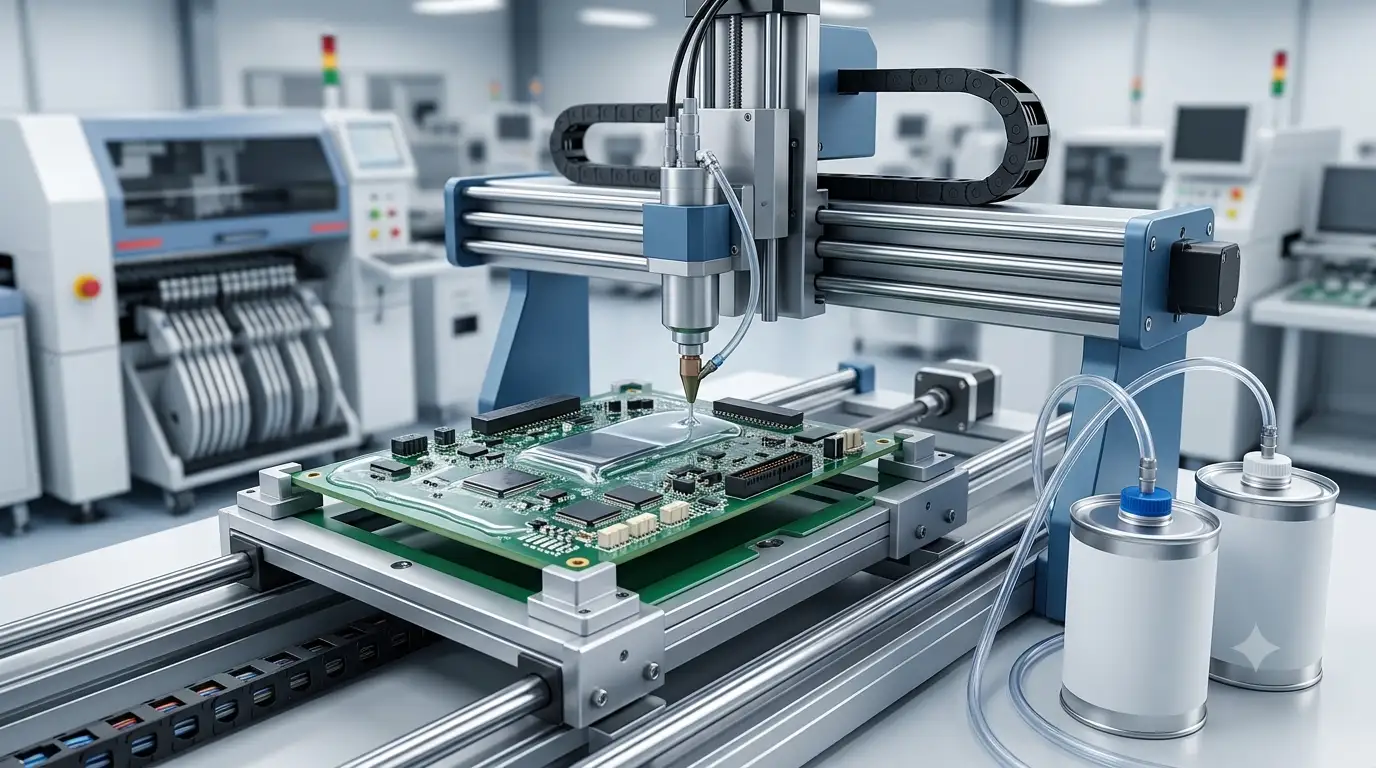
- Automated Selective Coating: A precise process using robotic arms that spray coating only where programmed, eliminating manual masking and optimising material use.
Conformal Coatings Types — A Complete Guide
There is no single coating that works for all applications. The Conformal Coatings types must be selected based on the operational environment the PCB will encounter.
1. Acrylic Resin (AR)
One of the most common types. Acrylic coatings dry quickly, are easy to remove and rework, and are easy to apply. They provide very good protection against moisture and some protection against fungus. They are usually stable to approximately 125°C but provide limited resistance to strong chemical solvents.
2. Silicone Resin (SR)
Silicone coatings excel in extreme temperature applications. They remain flexible and protective from the most extreme cold (−40°C) to the most extreme heat (200°C+). Their natural flexibility also offers great vibration absorption. However, silicone is very difficult to remove when a board must be repaired.
3. Polyurethane (UR)
Urethane coatings are known for their very hard finishes, offering unparalleled resistance to chemical solvents, abrasion, and mechanical wear. They are suitable for applications in aerospace and heavy industries. The drawback is that they are difficult to rework and typically require very aggressive chemical strippers.
4. Epoxy Resin (ER)
Typically provided as a two-part thermosetting compound. Epoxy coatings provide a hard, nearly impervious surface to moisture, abrasion, and chemicals when cured. Like urethanes, they are extremely hard to remove and may shrink during curing, placing mechanical stress on fragile components.
5. Parylene (XY)
Parylene is unique — it is deposited by a chemical vapor deposition (CVD) process in a vacuum chamber. The parylene polymerizes directly on the board as a gas, producing a completely even, pinhole-free coating even between tightly spaced components. It provides the highest level of protection but is the costliest option and is typically used only for critical medical devices and aerospace avionics.
Did you know that fact? The parylene coating process is so delicate that it has also been used to preserve waterlogged artifacts recovered from the Titanic.
Conformal Coatings and Cleaning Uses Across Industries
The Conformal Coatings and Cleaning uses span a wide range of industries where reliability and safety are paramount:
- Automotive Industry: Modern cars are essentially computers on wheels. Conformal coatings protect electronic control units (ECUs), sensor arrays and battery management systems from underhood temperatures, road salt, engine fluids, and extreme vibration.
- Aerospace & Defense: Satellites, drones, and military communications equipment are exposed to extreme temperature changes, humidity, and shock. Cleaning and coating processes are therefore mission-critical.
- Medical Devices: Pacemakers, hearing aids, and diagnostic devices must be fully sealed from bodily fluids and moisture to ensure they work perfectly and keep patients safe.
- Consumer Electronics: Smartwatches, washing machines, and outdoor security cameras increasingly use conformal coatings to protect against spills, daily wear and tear, and weather.
Did You Know? Ultra-pure deionized water—chemically "hungry" water—is used as an aggressive solvent to clean boards to perfection prior to coating, an essential step in modern electronics manufacturing.
Understanding the Supply Chain in India
Understanding the processes is one thing — having reliable suppliers is another. Whether you are establishing a new production line, improving an existing one, or managing costs, an efficient supply chain is essential.
Engineers and procurement managers often search for Conformal Coatings and Cleaning near me to locate local stockists for quick prototyping and urgent rework needs. Local sourcing is excellent for minimizing lead times.
For large-scale production, particularly in fast-growing industrial hubs, regional and national supply networks are equally important. India's electronics manufacturing services (EMS) industry has grown hugely over the past decade, and today there are strong Conformal Coatings and Cleaning Manufacturers in India producing world-class acrylics, silicones, and specialized cleaning agents. Buying directly from manufacturers offers cost benefits and direct technical support for custom chemical formulations.
A broad distribution network has also been established. Manufacturing plants can access both international and Indian brands through reputed Conformal Coatings and Cleaning Suppliers and Dealers in India. These suppliers often provide valuable value-added services such as application equipment recommendations, chemical guidance, and compliance with environmental regulations.
For high-mass production EMS companies producing millions of components per year, it is best to deal with Conformal Coatings and Cleaning wholesalers and Traders in India. Whether it is 55-gallon drums of solvent cleaners or bulk quantities of polyurethane coating, wholesalers can supply production lines with the volumes needed to keep them running without interruption.
About IMTronics
IMTronics Technology is an authorized manufacturer, exporter, distributor, dealer and supplier of world best class quality durable SMT machines, SMT related tools and components to streamline electronics manufacturing. Established with the objective to make life simple to manufacturers, the IMTronics Technology provides Electronics Manufacturing Solutions including world’s best in class SMT Machines and PCB Assembly Solutions. It supports manufacturers to achieve efficient output, with high quality standards and operational productivity under expert guidance of Anoop Kumar Mishra & Deepak Kumar Jha, it is able to fulfil all the technical and manufacturing requirements of customers at competitive rates and can assist them reduce down-time. IMTronics Technology has also got the honor to be an ISO 9001:2015 Certified Company.
Conclusion
As complex as the science of extending the life of an electronic assembly is, it really comes down to two key steps that cannot be compromised: cleaning the substrate to remove all harmful contaminants and applying a precisely selected conformal coating that seals off environmental threats.
Manufacturers who understand the different Conformal Coatings types — from flexible silicones to extremely durable parylene—and who respect the importance of pre-coating cleanliness can significantly decrease failure rates and warranty claims. Engaging strategically with trusted local and regional suppliers enables electronics manufacturers to optimize their production lines, lower costs, and ensure that the electronics they build today continue to perform well into the future.
Request a Quote Today!
Enhance the life of your electronics with our reliable PCB Conformal Coating and Cleaning solutions. Contact us today!
Frequently Asked Questions
Conformal coatings are a microscopic coat of polymer applied over a printed circuit board (PCB) to provide protection. This barrier protects the electronics from environmental hazards such as moisture, dust, salt water, corrosive chemicals, and other factors that can cause short circuits and reduce the life of electronics.
Any corrosive substances—such as solder flux residue, particles, or handling oils—remain under the coating if the board is not properly cleaned. Rather than protecting the board, the coating seals these hazards directly against the delicate circuitry, causing corrosion and early failure.
The best coating depends on the device's operating environment:
• Acrylic (AR): For general moisture protection and when the board may need future repairs.
• Silicone (SR): Best for high-vibration and extreme-temperature applications.
• Polyurethane (UR) & Epoxy (ER): Best for the roughest industrial environments requiring high chemical and abrasion resistance.
Yes — but the level of difficulty varies greatly by material. Acrylic coatings can be removed easily with mild solvents, allowing straightforward rework. More durable coatings such as Polyurethane and Epoxy are extremely difficult to remove and generally require harsh chemical strippers or mechanical scraping, which can potentially damage the underlying board.
Most coatings are applied as liquids by brushing, dipping, or spraying, whereas Parylene is applied as a gas at room temperature in a vacuum chamber. This chemical vapor deposition (CVD) process provides the greatest protection for critical medical implants and aerospace equipment, forming a pinhole-free seal even with extremely close tolerances between microparts.