
One spark that you don't feel, can cause the destruction of a chip that you can't fix. Electronics factories have a silent threat within their walls. With each step people walk, static accumulates, whether it is a walk of the walkman, moving chairs, or handling boards. If this charge crosses over to sensitive electronic components, damage can occur, sometimes without notice. Some parts don't work at all. Some go through inspection and yield weeks later – after the batch has shipped. By that time it is difficult, tedious and costly to trace the cause.
This is where ESD flooring comes into play. It is part of a larger static-protection system, providing a safe, controlled path away from your people, benches and boards. The remainder of this article discusses how that protection would operate and what to check before you invest.
ESD Flooring –What Is It and Why Is It Important?
ESD flooring is a type of floor surface engineered to resist the accumulation of static electricity. It employs conductive or dissipative materials which transfer charge at a controlled rate to ground. In the electronics manufacturing arena, this is important at all levels. PCB assembly lines, test areas and storage zones all accommodate parts failing at minuscule voltage levels. Normal flooring may actually be part of the issue. Anti-static flooring helps maintain the reliability of the product and yield in these workplaces.
How Does ESD Flooring Protect Electronic Components?
ESD flooring is not the end all, be all solution. It works in conjunction with personnel grounding, footwear and the controls on workstations to provide electrostatic discharge protection throughout the entire production area. They form a "kill before-the-component" stage that eliminates uncontrolled static before it reaches a component.
Controls Static Electricity Build-Up
Without motion there is no static. Friction is generated by walking, sliding a chair or lifting a tray, which generates charge. If not controlled, the charge continues to mount. Static electricity control is properly prevented from building up. ESD footwear and ESD flooring for electronics manufacturing act together to allow charge to exit the body at all times, and thus never accumulate to a dangerous level near exposed components. Simple, but very effective.
Provides a Controlled Path for Static Dissipation
Materials are divided into two categories:
- Conductive flooring: Has low resistance and charge moves rapidly.
- Static dissipative flooring: With slightly higher resistance levels, releases charge at a slower and safer rate.
The former leads to a grounding point via copper strips or earth bonding, while the latter leads to a grounding point via a set of copper strips. That connection matters. If that is not done, the floor will only store charge. In it, static dissipates in a controlled manner. The drain in the sink is the grounding drain.
Reduces the Risk of Electronic Component Damage
Semiconductors, ICs and PCBs can break down at voltages which people can't feel. There are some mistakes that are immediate. Others are hidden. The actual culprit in this is latent damage. The weak part might pass the test, and break in the field after months. It's expensive and difficult to track. Good ESD protection for electronic components reduces these risks, and good PCB assembly protection protects the boards from initial assembly through the packing.
Key Benefits of ESD Flooring in Electronics Manufacturing
The benefits of ESD flooring are seen on the shop floor and in quality reports. Here is how. Less static events leads to more consistent production, less audit issues and more confidence in each batch off the floor.
Assist PCB Assembly and SMT Production
PCB lines are quick and accurate. Static risk is never off duty as the component-handling and assembly areas are constantly moving, as are storage racks. ESD flooring for PCB assembly provides a common level of protection to these areas. For SMT manufacturing, where the parts are so small that they're packed tightly together, that consistency ensures that handling is safe from one shift to the next.
Helps Reduce Defects and Production Rework
Time is money—all failures of ESD cost more time. Teams troubleshoot, retest and rebuild boards, which should work the first time. PCB defect prevention is helped by good static control, eliminating a hidden failure cause. This translates to less returns, less rework and a more relaxed production process. This consistent output also establishes a good reputation with buyers that conduct supplier audits for quality and compliance.
Common ESD Flooring Solutions Used in Industrial Facilities
It is not common for facilities to have the same type of flooring throughout. The types of choices that can be made are determined by the area, the degree of traffic and risk associated with the area, so it's best to know the different options before shortlisting.
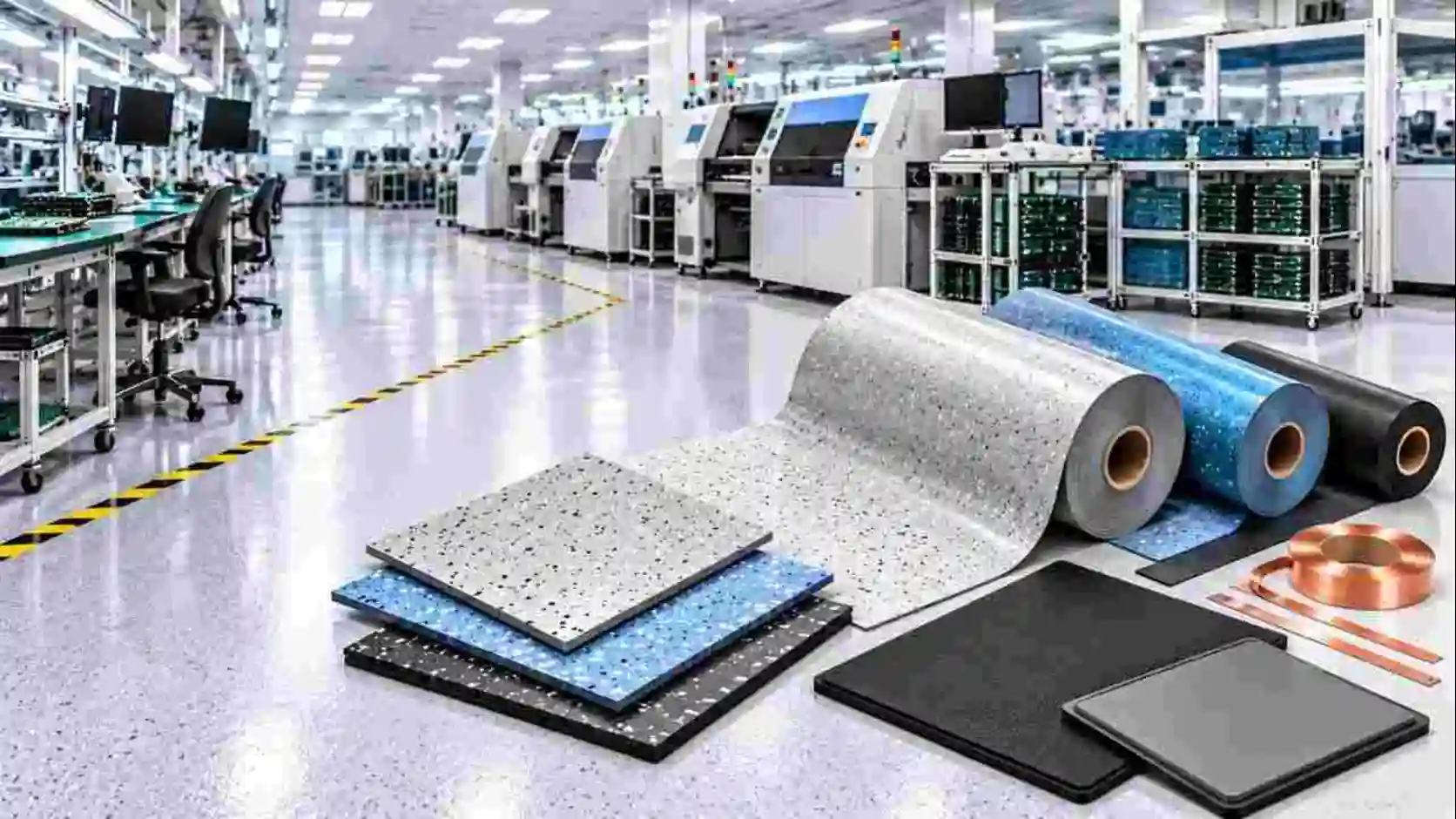
- Modular ESD floor tiles are ideal for use in full production halls and heavy traffic.
- ESD rubber mats are suitable for use at workstations, benches and test stations.
- These conductive and dissipative systems are supplied in rolls or sheets and cover large areas, continuously.
- These are full floor systems that cover the entire floor, or localised systems that cover a single workstation.
A great number of plants use a mixture of both, and add mats at important stations.
Important Factors for Effective ESD Flooring Protection
Purchasing the flooring is just half the battle. These checks determine its performance after it is put into production on your shop floor.
- The ESD rating and sensitivity of the product must be matched with resistance performance.
- Proper ESD flooring grounding to an approved earth ground point.
- Footwear compatibility – shoe and floor constitute one path.
- Appropriate adhesive and bonding for ESD flooring installation.
- Regular cleaning with approved products, as residues can lead to resistance.
- Testing periodically to ensure the floor is working as it did on day one.
A floor can't stand alone. It should be incorporated within an effective ESD control programme.
Why Choose IMTronics Technology for ESD Flooring?
The most important part of the choice is the partner as well as the material. IMTronics Technology is one of the top ESD flooring suppliers in India, catering to electronics manufacturers who cannot afford any failures due to static.
ESD flooring solutions has a variety of ESD tiles, mats, and associated ESD products for use on complete production floors and individual workstations.
The team can provide buyers with their layout, flooring area and risk level. IMTronics Technology will then assist in determining the correct protection for your workplace, to match your process.
Protect Electronic Components with ESD Flooring
ESD flooring aids in the dissipation of charge and compliments grounding and footwear safety for sensitive electronics. The outcome is enhanced electrostatic discharge protection, reduced failures and more reliable products. The well planned floor is a small investment that insures each part of your line.
|
Check out the ESD flooring product page at IMTronics Technology and make your inquiry today. |
Frequently Asked Questions
ESD flooring is a floor system that is engineered to control and safely dissipate static electricity. It has conductive or dissipative material which is grounded to protect static-sensitive parts and assemblies during electronics manufacturing.
No, if there is no grounding connection, the floor won't be able to dissipate static electricity effectively. If there is no ground, charge can build up on a person, tool or board and then flow away safely when there is ground.
Conductive Flooring has a lower resistance and faster charge release rate. Static dissipative flooring possesses a greater static resistant property and releases it at a slower rate. It is dependent on your ESD standard and your process risk to determine what type is suitable for each area.
PCB lines are subject to continuous movement and manipulation of very small and delicate components. In assembly stations, ESD flooring prevents static build-up and stops any hidden damage, defects and unnecessary re-work during production.
Testing should be conducted in accordance with the testing program established in your ESD control program. Many plants test regularly and on any repair, clean and/or layout change to ensure that the floor is still performing.
Single workstations are well protected by mats, but areas around the workstations are not. Full ESD flooring provides greater protection where there are clearances between stations. A lot of facilities employ both of them simultaneously to get greater coverage.