
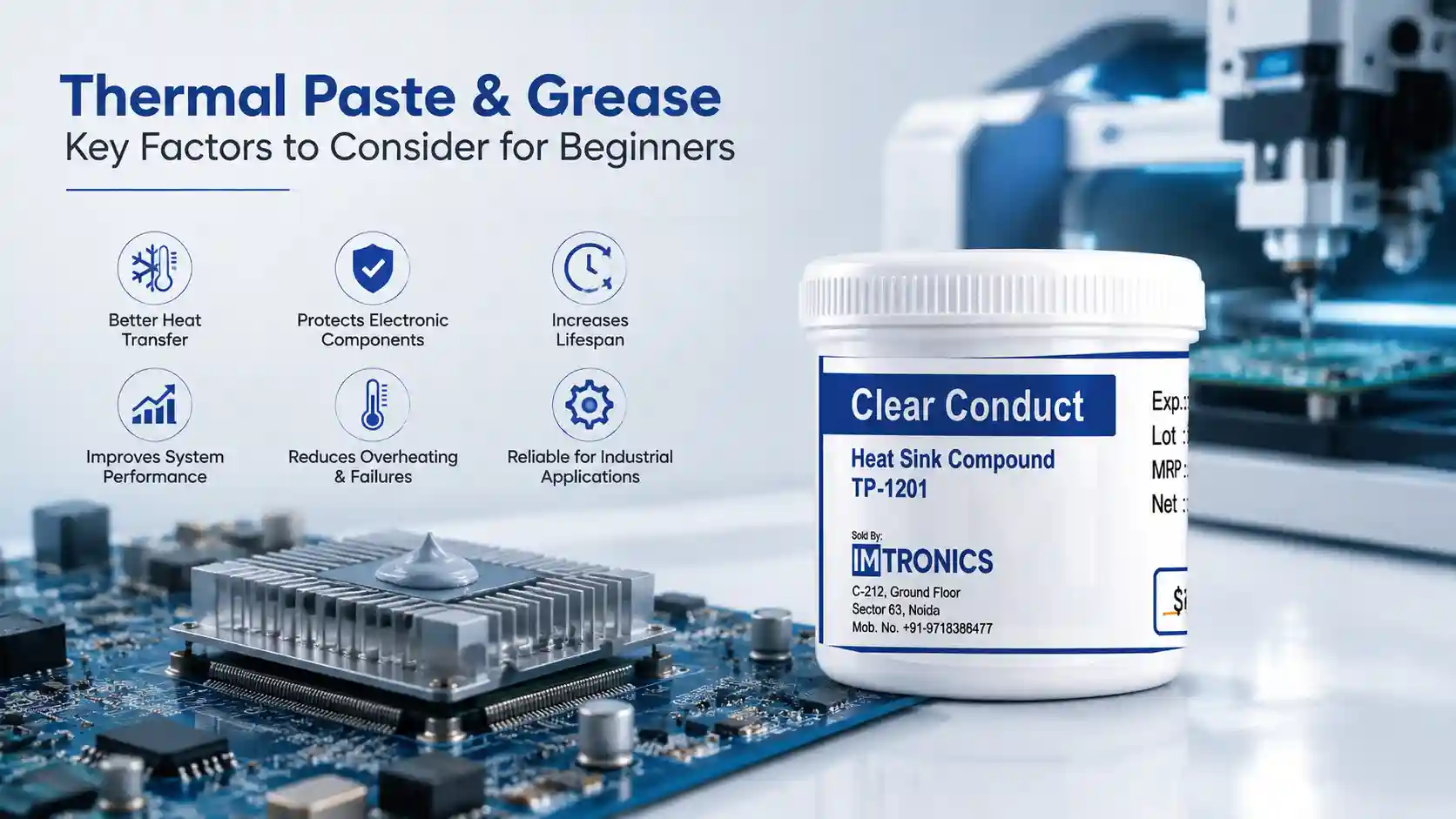
How to keep those electronic components working optimally The electronic parts' performance is directly connected with temperature. CPUs, GPU's, power transistors, LEDs, and any others producing much heat need to have an effective way to transfer heat from their tops. This is where thermal paste/grease finds its use. Whether you are trying to purchase thermal paste & grease for computers, other electronic devices, LED components and systems, or other various applications, knowing general selection criteria can ease your shopping. Read the following blog.
What is Thermal Paste and Thermal Grease?
Thermal compounds or grease are defined as compounds that transport the heat from the electrical components to a heatsink or any thermal transferring surface. When placing the two surface areas against one another, microscopic air gaps will exist in the interface between these surfaces. The terms thermal grease and thermal paste are often used interchangeably although these types of compounds vary between conductivity and thickness of material, and usage.
From a beginners perspective, deciding on the right type of thermal compound may seem a little tricky because they vary on thermal conductivity, viscosity, application method, operating temperature, and compatibility, among other things, and knowing certain factors of the thermal compound helps with selection for individual applications. Heat-transfer compounds are added to establish a better thermal pathway in which the electrons can pass through. Air doesn't transfer heat very efficiently.
Always choose reliable thermal paste & grease suppliers and dealers in India who know and understand product details.
Fun Fact: “Thermal paste does not replace a heatsink or cooling system. Its job is to improve the contact between the heat-generating component and the cooling surface.”
Importance of Thermal Paste
Thermal components give off heat as a result of their work done. Not carrying the heat efficiently away from thermal components causes thermal stresses that lead to decreased performance and service life of many electronic devices.
When applying thermal compound it:
- Improves heat transfer on contact surfaces.
- Reduces temperature spikes in electronic systems.
- Increases component's service life by reducing heat stresses.
- Supports lower thermal resistance on its path with the device itself.
- Minimum amount of microscopical irregularities between contact surfaces.
- Has less thermal resistance than that of the air or air gaps between the contacts.
Thus, thermal paste applications are valuable at various situations where maximum heat management is possible. For a smooth process choose trustworthy thermal paste & grease manufacturers in India like IMTronics.
Did You Know? “Even surfaces that appear perfectly smooth can have microscopic imperfections. Thermal paste fills these tiny gaps, helping create a more effective thermal connection between two surfaces.”
Key Factors Need to Consider For Thermal Paste & Grease
Here are the major factors to consider:
Thermal Conductivity
This is one of the most obvious indicators of whether you've chosen a product of adequate thermal conductance. This will represent how much heat the paste itself can handle. Thermal conductivity, however, cannot be the sole specification examined due to various external factors influencing heat transfer.
Viscosity
The viscosity of a thermal compound describes its ability to spread at a certain pressure with force. High viscosity compounds do not easily move while low viscosity compounds spread with ease and force in the required spot.
Operating Temperature
You should examine thermal compounds based on what temperatures the compound itself is set to tolerate. Electronics manufacturers are now testing various types of software and electrical units under different pressures or temperature environments in which there's heat being transferred or generated. Hence, selecting based on operating temperatures may be important.
Electrical Properties
Most often, manufacturers mention whether a thermal compound is electrically conductive or insulating. It may be advisable to use an electrically insulating type if it is likely that the contacts will come into any sort of accidental connection to the other parts of the electrical circuitry it is fitted to.
Material Compatibility
The thermal compound interacts with whatever surface it touches. Ensure it is not just safe to your metal or ceramic surfaces, but suitable for the specific electrical components and packaging material it is going to interact with. Consulting device manufacturers before choosing a product is recommended.
Application Method
Some thermal compounds need to be spread evenly and accurately across a given surface; other types use a needle applicator method that would effectively apply tiny amounts within a specific region. Beginners are advised to use compounds that come with an appropriate application method to ease installation and guarantee a consistent amount in each installation.
Long Term Stability
One important benefit of many heat-transfer compounds is their consistent working over a prolonged duration of use. Compounds should remain effective despite drying or having a decreased fluidity throughout use.
IMTronics is the leading thermal paste and thermal grease wholesalers and traders in India with years of experience.
About IMTronics
IMTronics Technology is an authorized manufacturer, exporter, distributor, dealer and supplier of world best class quality durable SMT machines, SMT related tools and components to streamline electronics manufacturing. Established with the objective to make life simple to manufacturers, the IMTronics Technology provides Electronics Manufacturing Solutions including world’s best in class SMT Machines and PCB Assembly Solutions. It supports manufacturers to achieve efficient output, with high quality standards and operational productivity under expert guidance of Anoop Kumar Mishra & Deepak Kumar Jha, it is able to fulfil all the technical and manufacturing requirements of customers at competitive rates and can assist them reduce down-time. IMTronics Technology has also got the honor to be an ISO 9001:2015 Certified Company.
Application of Thermal Paste and Thermal Grease
Thermal paste/grease is a necessity for a lot of electrical gadgets such as:
- Telecom
- Transistors
- Power module
- Semiconductors
- CPUs and GPUs,
- Power electronics
- LED lights systems
- Automotive devices
- Electronic assembly
- Industrial equipment
- Heat sinks and cooling assemblies
The right product varies depending on the working context, component type, and longevity required. For quality products reach IMTronics who provides the best thermal paste & grease.
|
Here is another blog you might be interested in. |
Product Specification
The following table talks about the product specification of thermal paste.
| Parameter | Specification |
|---|---|
| Base Material | Silicone-based / non-silicone / metal-filled compounds or similar formulations, as per application requirement |
| Thermal Conductivity | Typically formulated to support heat transfer between contact surfaces, depending on material composition |
| Viscosity | Medium to high viscosity paste, suitable for controlled application, as per requirement |
| Operating Temperature | Suitable for electronic thermal management conditions, depending on formulation and usage |
| Electrical Properties | Electrically insulating or conductive variants available, as per application need |
| Consistency | Smooth, spreadable consistency designed for uniform layer formation, depending on usage |
| Curing / Setting | Non-curing/semi-curing/curing/treatment types or like, will depend completely on which type of product you are looking at |
| Stability | Typical use under conditions that may cause them to dry out or crack, or otherwise, to be forced from the surface due to normal operating conditions |
| Application Method | Manual application / automated dispensing or similar methods, as per requirement |
| Compatibility | Suitable for heat sinks, ICs, processors and power devices, as per usage |
| Packaging | Syringes, tubes, jars or similar packaging options, depending on handling need |
| Storage Condition | Stored in controlled temperature conditions, as per material handling guidelines |
| Application Area | The use of electronics cooling and thermal interface management in the assembly of printed circuit boards |
| Availability | Generally available, subject to product type and order requirement |
Disclaimers: Technical specifications are only provided for general reference. Technical specifications for a product should not be construed as being the primary source of product information. The actual specifications of any given product may vary from these statements based on model, configuration, application requirements, or other factors as a result of continuous development activities.
For models to be used in critical applications, the specifications, such as performance, size, materials, and features, may change without notice. Users are encouraged to confirm the final specification before placing an order for the product or using the product in critical applications.
Common Errors by Beginners
Selecting the thermal compound only based on a good thermal conductivity value may be an error. Its conditions of use and its compatibility are essential. In addition to this mistake, here are a few additional problems with the choice or application of a thermal compound:
- Not enough paste applied
- Using a poorly adapted formula
- Too much thermal paste applied
- Forgetting about their electrical conductivity
- Forgetting to clean surfaces before application
- A product not adapted to working temperature
- An obsolete or poorly stored thermal compound
- Believing a thermal compound is compatible with any situation.
To avoid these problems, you need to buy thermal paste & grease from a reliable source like IMTronics.
Case Study
A consumer electronics producer decreased thermal stress and thus enhanced the efficiency and reliability of its electrical devices by using a thermal compound that best suited its manufacturing process.
Varieties of Thermal Paste and Grease
Here are some of the varieties:
Ceramic Thermal Paste
Efficiently conducts heat and remains electronically isolated.
Metal-Based Thermal Paste
A robust, heat-efficient substance designed for high performance demands.
Silicone-Based Thermal Grease
A pliable and easy-to-apply substance good for general-purpose thermal conductivity.
Industrial Thermal Grease
Appropriate for heavy-duty electronic, industrial, LED, and power components where sustained thermal conduction is needed.
Why Choose IMTronics for Thermal Paste & Grease?
Here are some of the reasons:
- They have a wide application range.
- They provide high-quality thermal solutions.
- They have a strong and trusted supply reliability.
- They provide paste and grease in bulk amounts without compromising the quality.
Conclusion
A beginner doesn't need to make a selection of a thermal compound complex. An understanding of thermal conductivity, viscosity, thermal resistance, electrical insulating behavior and a sense of what substances are electrically compatible with itself plus the nature of application of a chosen substance plus the lifespan of product to give the correct application material for your work.
|
Searching for thermal paste & grease near me then go and contact IMTronics now. |
Frequently Asked Questions
- Service life
- Application
- Temperature
- Application process
- Thermal requirement
- Surface compatibility
- Electrical characteristics
Thermal paste & grease price can vary according to formulation, performance requirements, packaging, quantity, and application. Compare technical specifications and suitability rather than price alone.
Replacement depends on the application, operating conditions, product formulation, and equipment manufacturer's recommendations. It should generally be replaced when thermal performance deteriorates or during recommended maintenance.
No. The compound should be selected according to the component, surface materials, operating temperature, and electrical requirements.
Industries can reach to IMTronics to find quality thermal paste as they provide a reliable and efficient means of cooling and operating electronics and industrial systems while maximizing performance.