
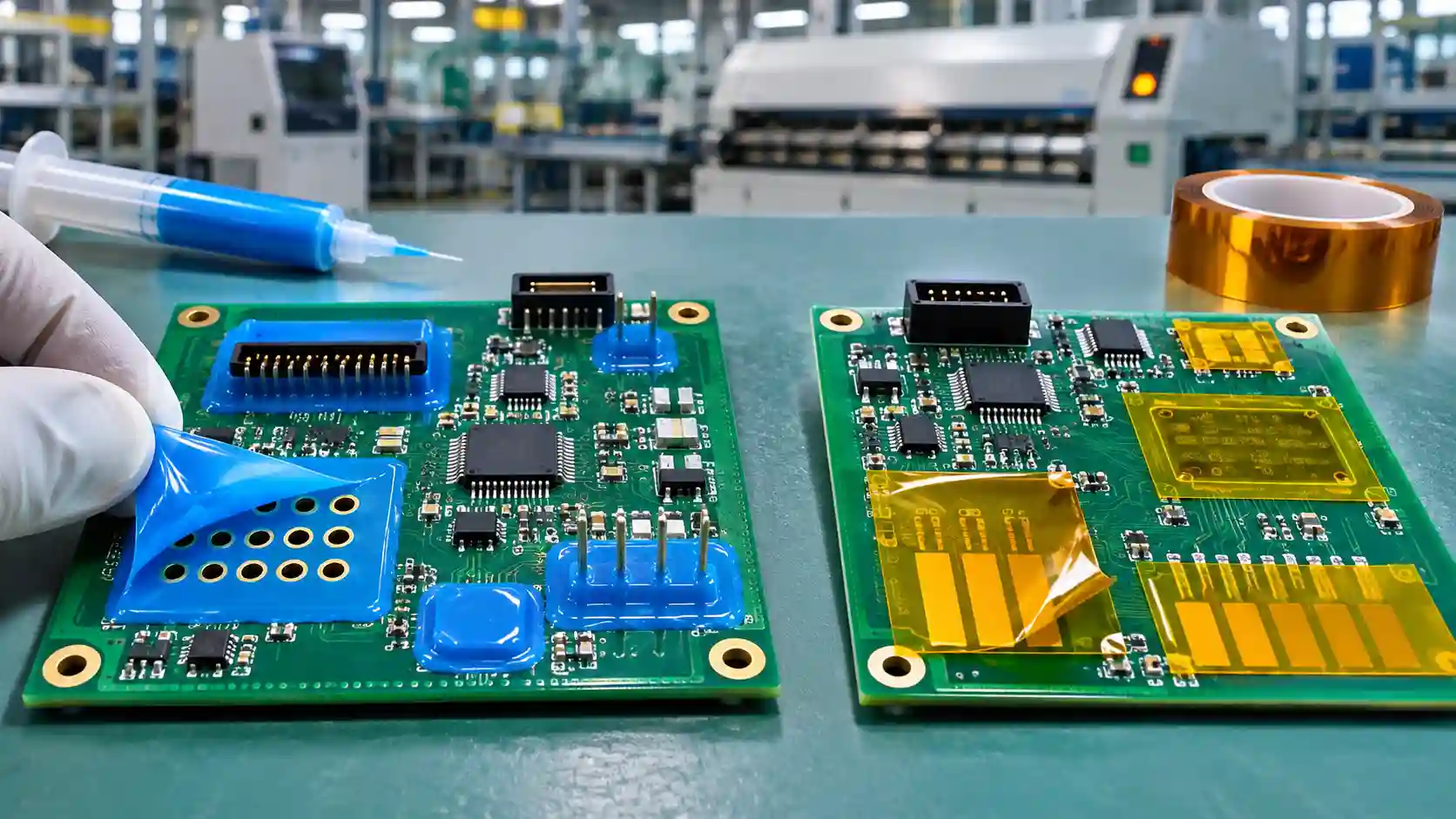
over a test pad will flunk the board in the final inspection. And protectant - temporary protection - fixes both. But your choice of approach affects your speed, your rework ratio and the board's final appearance.
This guide compares the two options. Here you'll learn: Where a peelable mask for PCB work surpasses tape the PCB masking materials that are worth a test first.
How Each Method Works
A peelable solder mask is a rubber or liquid latex like material. You apply it, allow it to cure as a flexible film, run the process and peel it off. Best for connectors, plated holes, gold contacts & test points. Tape is another. High temperature masking tape (typically polyimide-based) is trimmed to shape, then pressed onto the part. As a uniform sheet with a thin layer of adhesive on its surface, it will cover both flat pads and wider openings cleanly.
One more thing, peeling masks are sorted into families, including latex, non-ammoniated and washable. Chemistry is determined by how your film interacts with gold and other precious-metal finishes, and how it cleans up. Check the data sheet before you purchase.
Peelable Mask vs Masking Tape: Key Differences
The peelable mask vs masking tape question boils down to six checks. Check each against your own line, as all PCB masking methods behave differently from one process to the next. We’ll compare the two options in a table first, then go through each check in detail below.
| Factor | Peelable Mask | Masking Tape |
|---|---|---|
| Application | Brushed or dispensed; fits corners and pins | Hand-cut; crisp edge, operator-dependent |
| Heat resistance | Must be rated for wave soldering | Must be rated; adhesive may soften |
| Removal | Can tear if over-cured | May leave adhesive residue |
| Cost and time | Better for repeat, high-volume runs | Better for low volume |
| PCB design fit | Fine-pitch and dense areas | Large holes (over 3 mm) and flat pads |
| Conformal coating | Must resist coating chemistry | Coating can creep under the edge |
1. Application Method and Coverage Accuracy
Peelable mask application are you have to brush it on, squirt it out or use a stencil. The liquid flows under pins and into corners to get complete coverage on unusual shapes. Tape must be cut and positioned; prelanced dots are useful on regular flat pads, although irregularities require hand trimming – then accuracy is up to the person doing it. PCB masking tape provides a crisp, clean edge.
2. Temperature Resistance and Process Compatibility
Wave soldering peaks a board with flux, molten solder and heat, even for a brief time. Both options can handle it, but only if they are rated for it. You will see that heat resistant masking tape has different adhesives, and some adhesives soften or transfer when heated. Peelable masks also differ by formulation. Always choose the rating according to your PCB Assembly profile.
3. Removal Process and Residue Risks
Things can go wrong with both methods during removal. Being aware of how each method will fail means that you can choose which material to use and take greater care in how you de-mask.
- Easy to peel a cured film when the application is suitable.
- A mask that has been cured too hard may tear, break into little pieces in tight spots or even lift a component lead. That is the number one peelable mask removal risk.
- New tape is not always the problem because the adhesive might remain on the pads and on the gold contacts.
- This masking tape residue can compromise electrical contact or the adhesion of coatings.
- De-masking can also be the source of static charge so use an ionizer where the boards are sensitive.
4. Production Time and Application Costs
Tape seems cheap until you factor in labour. Cutting and placing everything, and checking it all takes minutes per board. Liquid masks take time to dispense and cure but are perfect for repeat patterns. So PCB masking cost varies by volume, by layout and by operator. Low volume usually prefers tape. Repeated layouts usually prefer liquid. Time a real production batch before you decide.
5. Suitability for Different PCB Designs
Pitch of the connector, plated through holes, clearance of the components, things like that matter. Liquid masks work well with fine-pitch connectors or dense areas. Keep in mind that sometimes large holes (more than 3 mm) are simply better to cover with tape.
Allow for grasping the cured film. Good PCB protection begins at the design stage, before running the line.
6. Behaviour During Conformal Coating
A third test is coating. Tape will leave a parting line and coating will, if the seal isn't tight, crawl under the tape edge. Liquid mask follows contours but must be resistant to your coating chemistry without swell or solvent attack. Test the mask compatibility with your acrylic conformal coating before the run.
Quick Comparison: Peelable Mask vs Masking Tape
Use this table as a first filter, then confirm against your own data sheets.
| Factor | Peelable Mask | Masking Tape |
|---|---|---|
| Application | Brush, dispenser or stencil | Hand-cut or precut, pressed on |
| Curing | Air dry or short bake | None |
| Coverage | Flows into gaps and around pins | Best on flat, regular areas |
| Residue Risk | Low when cured correctly | Adhesive residue possible |
| Process Compatibility | Wave soldering and coating, check rating | Wave, reflow and coating, check adhesive |
| Production Volume | Repeated patterns | Low volume or one-offs |
| Removal | Peeled off, often in one piece | Lifted, sometimes cleaned |
| Best For | Connectors, vias, irregular zones | Flat pads, larger holes |
| Typical Failure | Tearing, over-cure | Residue, coating creep under edge |
| Operator Dependence | Moderate | High |
When Should You Choose a Peelable Mask?
Choose the method that fits. Use these as a guide.
- A liquid mask is best suited for repeated patterns, dense connectors and random shapes.
- Use tape if pads are flat and you need bigger holes or if your work is low-volume.
- Combine the two when the one board has both a printed and a touchscreen area.
Hybrid combinations are standard. Tape fills wide spaces, and liquid masks safeguard narrow areas. It's a reasonable approach to accomplish temporary PCB masking - just don't impose one solution on every board. Stock some polyimide tapes, and those jobs will never be out of reach.
What to Check Before Buying Peelable Mask
The data sheets reveal much. Here are the most important issues to consider before buying and the seller should be prepared to substantiate each claim.
- Cure conditions and time
- Viscosity for your application method
- Temperature resistance for your actual process
- Shelf life and storage conditions
- Compatibility with flux, coating and board finish
- Batch-to-batch consistency
Next, do a sample test. Use the mask on the scrap board, cure it as recommended, test it on the actual process, peel it and check the pads. Take a look at peelable mask suppliers in India for the documentation, stock levels and technical support.
Why Choose IMTronics Technology for Peelable Mask?
An elusive mask material has a guaranteed delivery time and is consistent from lot to lot. This is what you can anticipate with IMTronics Technology when you make your purchase.
- Never wait for stock with our on-time delivery
- Superior quality products with ISO & RoHS complaint formulations.
- Bulk quantity orders at competitive wholesale pricing
- Available as bespoke pack size, application method and process requirements.
- Assistance with mask selection and sample testing
Conclusion
Peelable mask handles repeats, sharp corners and odd contours. Tape works well with flat surfaces, big holes and small runs. Several lines combine the two. Whichever you decide on, test it on your actual process with a sample board and read the data sheet first. Reputable peelable mask dealers simplify that research by providing samples and paperwork. IMTronics Technology will help you design the perfect masking solution for your line.
| Looking for a peelable mask for your PCB line? Contact IMTronics Technology today by phone or email for specifications, bulk supply and a quote. |
Frequently Asked Questions
Not necessarily. A peelable mask for wave soldering is ideal in dense or awkward areas, and tape may be better for flat pads. What's right for you? Make sure to consider your soldering environments, product ratings and board shape. Check ratings with your supplier.
Yes. It can. If it was under-cured, the wrong media or a difficult profile it could tear or leave bits behind. Peelable mask residue is not usually an issue if you cure as instructed and test a profile.
Compare supplier documents, product compatibility and stock availability. Reliable Peelable Mask Dealers in India share data sheets before you commit. IMTronics Technology lists its range on a dedicated peelable mask page.
Yes, primarily on flat surfaces – test pads and mounting holes. Use precut dots, and review the adhesive against the coating. Be careful of the coating moving under the edge of the tape.
It depends on the product. Some are air dry, some require a bake. How long, and at what temperature, check the data sheet and incorporate the cure step in the line before the first run.
Store tightly sealed in a cool, dry location. Mix only if specified on the data sheet. Please consult shelf life before use as usage can result in poor curing and can peel unevenly.