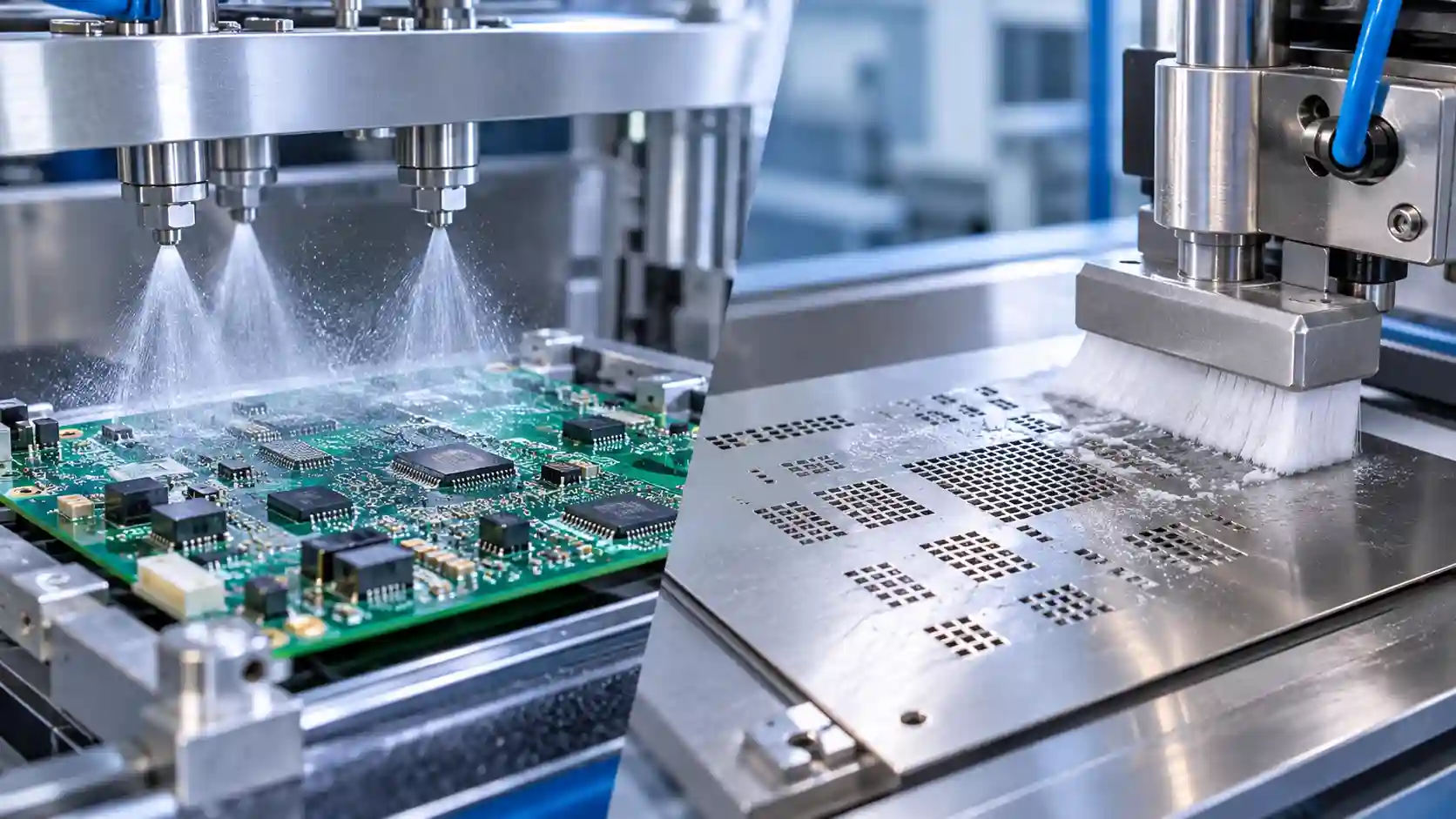
Cleaning plays an important role in maintaining quality and consistency in Surface Mount Technology (SMT) manufacturing. During the manufacturing process, while the PCB is being populated with components, solder paste and flux residues, dust and other particles can all affect the printing, the electrical performance of the circuit and the overall quality and life of the finished product.
Cleaning an assembled PCB, however, doesn't involve cleaning an SMT stencil, as PCBA cleaning involves the removal of contaminants from a completed circuit board, while stencil cleaning involves removing solder paste and other residues from the apertures and surfaces of the stencil.
What Are PCBA and Stencil Cleaning?
PCBA cleaning is the process of cleansing a printed circuit board (PCB) after the electronic components have been soldered. Once components have been soldered onto a PCB it is then cleaned, and this is to get rid of flux residues, ionic residues, dust and traces of surface handling.
Removal of excess solder paste, glue and other printing residues from SMT stencils is called stencil cleaning. SMT stencils have fine apertures that deposit solder paste onto PCB pads. If printing is performed on a regular basis, the apertures are not blocked and the printing results remain constant.
The process is critical in the SMT production stage but is distinctly different from the other process as they both have different cleaning systems and chemical compositions.
PCBA vs Stencil Cleaning: 5 Key Differences
While both cleaning processes can be applied to the production of electronics, they each have different purposes, contaminants and process needs. Here are five reasons why they are different from each other.
1. Cleaning Stage in SMT Manufacturing
Reprinting is normally done on the Stencil before installation of parts. During this process, solder paste will be applied to the target printed circuit board pads by the aperture of a stencil. Paste accumulated on the aperture may affect the print and therefore are regularly cleaned.
Stencils may be cleaned by the manufacturer between production runs, at specified intervals, or when inspection shows defective printing.
Typically, PCBA cleaning occurs after the soldering process, which will depend on the product and manufacturing process. After the components are assembled, flux residue and other impurities might still be on the board; cleaning can be necessary if the product cleanliness specifications dictate.
So stencil cleaning is part of the printing process, whereas PCBA cleaning is an element of finishing an electronic product.
2. Types of Contaminants Removed
The contamination on stencils will not match that of the assembled PCB.
Stencil contaminants include:
- Unused and dried solder paste deposits.
- Solder paste residues inside stencil apertures.
- Adhesive residues from printing processes.
- Dust and particles accumulated during production.
- Flux-related deposits from solder paste.
PCBA contaminants include:
- No-clean and water-soluble flux residues.
- Ionic contamination from manufacturing processes.
- Dust, fingerprints and handling residues.
- Soldering-related organic deposits.
- Other process-specific chemical residues.
Flux residue removal is critical for any contamination that may impact insulation resistance, corrosion resistance, or long term electrical reliability. Likewise, solder paste cleaning is required for stencil aperture integrity and printing consistency.
Concentrate on residue chemistry the cleaner has to be chosen on the chemistry of the actual residue. Not all electronics cleaning chemicals will remove everything.
3. Surface Compatibility and Cleaning Challenges
Cleaning stencils primarily refer to stainless-steel stencils and other suitable stencil media which have accurately punched out apertures. The apertures can be very small, particularly in fine pitch SMT applications. Cleaning has to remove the paste deposits without damaging the aperture rims, the surface of the stencil, or the coating.
PCBA cleaning are more complex due to presence of various materials and electronic components on assembled boards, including:
- Printed circuit board laminates.
- Plastic and metal connectors.
- Integrated circuits and semiconductor packages.
- Sensitive switches and sensors.
- Coatings, adhesives and component markings.
A portion of the parts may be resistant to some moisture, heat or specific solvents. Additionally, some assemblies may have areas where cleaning solutions can accumulate.
This is why it is very important to choose PCB cleaning chemicals that are suitable for the PCB board, as well as the components used and the manufacturing process. The amount of space between the parts, accessibility and whether or not they are wet also have an impact on the process.
4. Cleaning Chemicals and Application Methods
PCBA and stencil need to be powerful enough to break down or remove the residues and contaminants without harmful impact on the materials being cleaned.
Stencil cleaning methods and chemicals:
- Manual wiping using approved stencil cleaning solutions.
- Automated wiping systems for routine production cleaning.
- Wet cleaning systems for cleaning the integrated paste.
- Equipment-assisted cleaning for difficult-to-reach apertures.
Most SMT stencil cleaning chemicals are chosen for their suitability to different types of solder paste chemistry, according to the state of residues and the stencil media being used, either metal or polyimide. The chosen cleaner should lift deposits without leaving a film or affecting the stencil.
PCBA cleaning methods and chemicals:
- Spray cleaning using compatible aqueous solutions.
- Batch cleaning for suitable PCB assemblies.
- Solvent-based cleaning for specific residue requirements.
- Manual cleaning for certain repair and maintenance functions.
The flux removal, compatibility of the solution with the substrate material, rinse and dry performance has to be checked for the PCBA cleaning solution. The formulation has to remove contaminants but not harm delicate electronic parts.
Whether to use an aqueous or solvent clean depends on the type of residue, process and equipment conditions and levels of cleanliness required.
5. Cleaning Verification and Quality Requirements
Cleaning verification is done to ensure that the required results are obtained. But the PCBA and stencil cleaning inspection criteria are different.
Stencil cleaning verification includes:
- Checking for blocked or partially blocked apertures.
- Inspecting stencil surfaces for remaining solder paste.
- Checking for residue accumulation around openings.
- Reviewing solder paste printing consistency.
- Monitoring print defects after stencil cleaning.
PCBA cleaning verification includes:
- Visual inspection for visible residues and contamination.
- Testing for ionic contamination where required.
- Evaluating cleanliness against product specifications.
- Checking for trapped moisture or cleaning residues.
- Confirming electrical reliability requirements through suitable testing.
Verification by ionic contamination testing or other validated cleanliness testing technique may be employed. Choice of verification technique will be dependent on assembly configuration, customer requirements, and relevant industry standards.
PCBA vs Stencil Cleaning: Quick Comparison Table
The following table talks about the comparison between PCBA vs stencil cleaning.
| Comparison Factor | PCBA Cleaning | Stencil Cleaning |
|---|---|---|
| Main Purpose | Removes contaminants from assembled circuit boards | Removes solder paste and printing residues |
| Manufacturing Stage | Generally after soldering | During solder paste printing |
| Main Contaminants | Flux, ionic residues, dust and handling marks | Solder paste, adhesive and printing deposits |
| Cleaning Surface | Populated printed circuit boards | Stainless-steel or compatible stencils |
| Cleaning Chemicals | PCBA cleaning solutions | SMT stencil cleaners |
| Common Methods | Spray, batch, aqueous and solvent cleaning | Manual wiping and automated stencil cleaning |
| Main Challenge | Protecting sensitive electronic components | Cleaning fine apertures without damage |
| Quality Checks | Residue inspection and cleanliness testing | Aperture inspection and print quality checks |
| Desired Outcome | Reliable and clean electronic assemblies | Consistent solder paste printing |
Which Cleaning Methods Are Used in SMT Production?
SMT cleaning depending on the production requirement, where SMTs are produced, cleansing method and contamination level of residues, any SMTs cleaning process is used.
1. Manual Stencil Cleaning
Manual cleaning is cleaning with an approved solution using the appropriate wipes or cleaning material. Mostly used for maintenance, small production quantities and limited cleaning requirements. Attention should be paid to not damage small apertures.
2. Automated Stencil Cleaning
Automated stencil cleaning equipment cleans solder paste and other debris with several clean cycles. The machine may spray, wipe, rinse and dry depending on the model. This is a valuable option for manufacturers who work with regular stencil changes and large production runs.
3. Spray Cleaners for PCBAs
Spray cleaning employs directed liquid flow to eliminate flux residue and other contaminants from assembled circuit boards. Cleaning performance is influenced by spray pressure, temperature, chemical action and the duration of treatment.
4. Batch Cleaning
Batch cleaning is used when several suitable boards are being cleaned at the same time with the same cleaning conditions. It may be used for production, if the same cleaning parameters are to be used for each run.
In either process, the manufacturer should document critical operating parameters, such as chemical concentration, temperature, time of cleaning, rinsing quality and drying conditions. Control over the process can provide consistent performance and eliminate the risk of residual contamination defects.
How to Choose the Right PCBA and Stencil Cleaners
It is essential to have a clear knowledge of the manufacturing process, the contaminants involved, and materials compatibility. A cleaner that is effective for removing solder paste may not be compatible for removing flux residue.
- Ascertain whether the cleaning process is for solder paste, flux, adhesive, ionic contamination or process residues.
- This entails using the chemical to test the PCB, electronic components and connectors, and any other surfaces that might have been affected by the chemicals.
- Select a product that is suitable for use with manual, spray, batch and automated cleaning.
- Verify the product's cleaning properties, recommended conditions of operation, compatibility with materials, and instructions for use.
- Check whether this is needed and that the assemblies may be able to be dried out without inadvertently trapping water.
- Review the safety data sheet, instructions for use, storage and safety procedures of the work zone.
- An ideal PCBA and Stencil Cleaners Suppliers in India like IMTronics can provide the correct technical data, product suggestions, and application support.
Cleaning validation on typical production materials is performed to verify effectiveness before a chemical is introduced into normal production.
Common Cleaning Mistakes in SMT Manufacturing
Here are some common mistakes of cleaning:
- Doing the process to the restoration wrong could influence the quality of production. It can bring rework and many costs of maintenance for excess. These are the most frequent errors of cleaning:
- In cases where you are not certain if the chemical is compatible with the flux, the solder paste, or the PCB, you risk damaging the surface or inadequately cleaning it.
- If the stencil is not cleaned soon enough, the apertures can become blocked and this can affect the stencil’s ability to apply solder paste evenly.
- Incorrect setting of the temperature and pressure and excessive cleaning time may influence the cleaning performance.
- When rinsing is necessary and not well-managed, there can be lingering chemicals from cleaning.
- Moisture can cause problems with assemblies that have connectors, cavities and closely spaced items.
- Not inspecting cleaned stencils and PCBAs can result in defects caused by contamination to carry over into later processing steps.
Conclusion
PCBA and stencil cleaning are essential and unlike, the difference between these two types of cleaning is that they both have similar functions of cleaning but are specifically aimed at cleaning different assemblies. For instance, what has to be cleaned in PCBA cleaning is the assembled circuit boards while in Stencil cleaning it is focused on the accuracy of the solder paste printing. Both methods require cleaners that are able to remove any contaminations, the right application process and the right quality check.
Manufacturers should consider residue chemistry, equipment needs, compatibility with materials and process requirements prior to choosing a cleaning solution. The use of the right PCBA and stencil cleaner can help maintain consistency, control contamination related defects and facilitate high quality electronics manufacturing. Check out the line of IMTronics cleaning products and find the best PCB cleaning solutions and stencil cleaning solutions for your needs.
Frequently Asked Questions
PCBA Cleaning - flux residues, ionic contamination and other deposits are removed from assembled printed circuit boards Stencil cleaning - stencil cleaning removes solder paste and printing residue from stencil surfaces and apertures during SMT production.
The cleaner may be compatible with both applications only if the cleaning performance and material compatibility have been verified. The manufacturer should strictly adhere to the product specifications and perform application tests before they use one cleaner for both applications.
The frequency of stencil cleaning is determined by the type of solder paste used, aperture size and design, production rates and printing conditions. Stencils should be cleaned when appropriate based on process recommendations and when inspection or printing results show that residue build-up is happening.
Cleaning for stencil apertures keeps paste from filling in the holes. Improves printing consistency, reduces printing defects and improves solder joints.
PCBA clean is dependent on the nature of the contamination, the cleaning chemical formulation, temperature, cleaning duration and process parameters. Adequate rinsing and drying are necessary where applicable.
Yes. Most water-based products are water-based Aqueous-based, solvent-based cleaners that leverage different types of organic solvents for removing dirt. It all boils down to the type of residue to be removed, compatibility of components and cleaning machinery.