
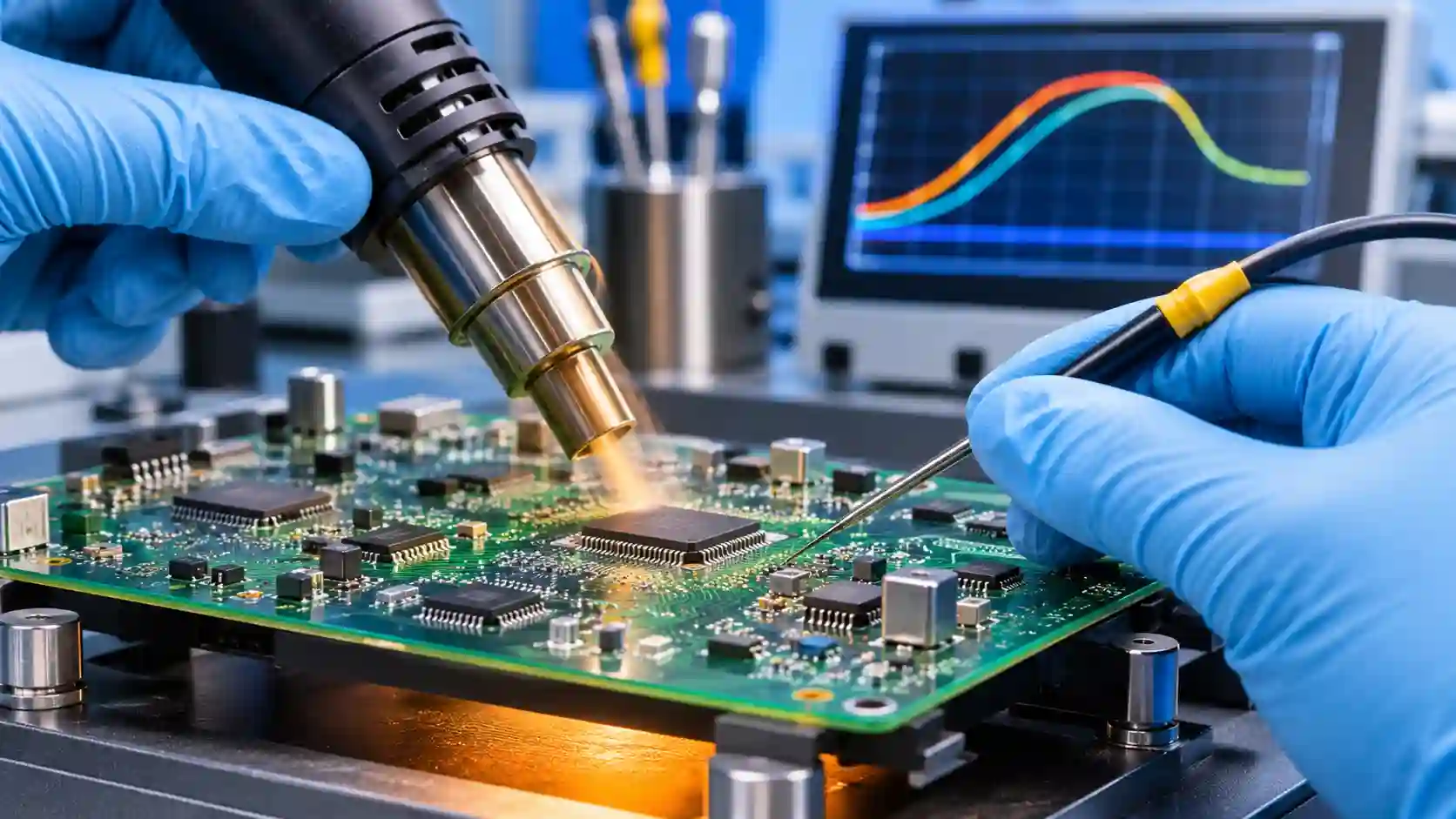
If a PCB is faulty, the objective is not only to remove or replace the faulty part, but also to repair the PCB. True success is board repair, with no damage to the substrate, adjacent areas, solder joints or the product's future viability.
That's why PCB rework temperature profiling is so important. Imagine a delicate electronic ecosystem that is stuffed with microscopic components, a PCB. The board may warp if one zone overheats or in general, and adjacent components may fail, and solder joints may become brittle. A quality PCB rework temperature profile will provide the correct amount of heat to the correct target area with a proper ramp rate for the exact amount of time.
It's an issue for which no electronics manufacturer, repair centre, EMS provider or bulk buyer would take responsibility. It's an issue that affects production yield, warranty claims, rework minimisation and customer trust.
What Is Temperature Profiling in PCB Rework?
Thermal profiling is the term for the process of measuring and controlling the temperature rise, maintenance and reduction within a board during repair. A hot air rework station (or desoldering rework station) doesn't heat up the workpiece indiscriminately, but instead follows a controlled heating curve that allows the solder to melt without harming the surrounding board.
The typical PCB Rework Process consists of four stages:
- Preheating: The whole PCB is heated gradually from below, which reduces thermal shock effect.
- Soaking: Equating uniform and stable baseline temperature of board and target component.
- Reflow: Heat peaks up to the melting point of the solder alloy and holds the temperature only long enough for the alloy to melt.
- Cooling: The assembly cools at a controlled rate resulting in a strong shiny solder joint.
It becomes particularly important during SMD component rework, when the miniature parts are very close together, fractions of a millimeter. To sum up, temperature profiling eliminates 'guess work' because it dictates exactly how hot the board becomes, how quickly it rises to the maximum temperature and how long it remains.
Why PCB Rework Needs Controlled Heat
Although a PCB appears to be a flat, solid piece of board, it is actually a sandwich of fiberglass, copper traces, solder masks, plastics and sensitive silicon chips. Each material expands at different rates when heated, causing uncontrolled mechanical fights amongst materials.
If heat is given indiscriminately, damage becomes apparent very rapidly:
- PCB thermal stress that compromises the layers of the board.
- Bending or warping of the board.
- Damage in the solder pad area as well as lifted copper traces.
- Cracked or heat damaged adjacent parts
- Debonded, weak, cold, or broken solder joints
- Moisture-induced delamination or "popcorning"
With lead-free soldering, it is essential to have precision. Compared to tin-lead solder, lead-free alloys require significantly higher melting points and thus have a much lower margin of error. When the heat is cranked up on the top even without a good thermal setup it will usually burn other components nearby and destroy the board.
The Role of PCB Preheating
PCB preheating is the back-up plan for all big-dollar repairs. If a technician points hot air directly at a board that is at room temperature, the area that is being heated expands quickly while the rest of the board remains below the melting point of the solder and cold, taut.
Having a gentle, uniform bottom side preheat creates a baseline temperature, which is usually in the 100-120°C range based on the thickness of the board and type of solder, and before the top side hot air ever turns on. This is a simple fix for avoiding thermal shock, ensuring the solder melts evenly across all pins, flat board and smooth and predictable lifting of components. Preheating is the answer for high-volume repair lines for unpredictable results, or repeatable daily consistency.
What a Good PCB Rework Temperature Profile Looks Like
There is no universal temperature curve that is applicable to all circuits boards. There are many factors that engineers need to consider when related to the thickness of the board, weight of the board's internal copper, the mass of the components, heat-sensitive components located near the board, the solder alloy, and the capabilities of the equipment. However, almost all of the trustworthy profiles adhere to a four-step pattern:
| Stage | Purpose | What Happens |
|---|---|---|
| Preheat | Prepare the board | The PCB warms gradually to reduce thermal stress |
| Soak | Stabilise the area | Heat spreads evenly through the board and component area |
| Reflow | Melt the solder | The solder reaches the required liquidus temperature |
| Cooling | Solidify the joint | The board cools in a controlled way to lock joint strength |
For complex BGA and CSP assemblies, industry standards are often for preheating to be around 100–120°C, soak at between 155–175°C and reflow at 230–240°C, depending on the board. When reworking with lead-free solder, care must be taken as the reworking temperature is frequently between 245°C-260°C, which is quite close to the melting point of the solder. Most importantly, technicians should not forget that the nozzle temperature that is set on a screen is not the solder joint temperature; it's what happens on the board that matters.
Why Thermocouple Measurement Is Essential
A thermocouple measurement provides technicians with eyes on the actual temperature that is taking place at the solder joint. Thermocouple is a thin-wire temperature sensor, which is fastened directly close to the rework area, and can measure the actual temperature of the board, not just the machine's air-heater temperature.
The heat is not distributed evenly over an assembly due to heavier ground planes, denser copper planes and bulkier connectors. Thermal balance is checked at the solder joint, component top, package corners and surrounding components with sensors. The live feedback allows operators to make adjustments to airflow, nozzle height, preheat, dwell times, and more with confidence, making rework a repeatable science.
Temperature Profiling for SMD Component Rework
SMD component rework is a process in which small surface-mount components such as chip resistors, ceramic capacitors, QFNs, connectors and BGAs are removed and replaced. The hot-air stream can be too big, too powerful, or too long, and parts can fall out of alignment or tomb-stone off their pads.
A professional desoldering rework station should provide the operator independent control over:
- The volume and speed of the airflow.
- Geometrical aspects of the focus nozzle and its size.
- Temperatures and ramp times on the top side
- Bottom-side preheat output
- Controlled post reflow cooling rate
- Closed loop temperature feedback with live temperature display.
With the very small passives, the aim is to achieve surgical heat isolation. In the case of large area-array packages such as BGAs, the problem becomes one of ensuring uniform heating of the package so that all the solder balls melt simultaneously, rather than lifting at different times, tearing the pads off the board.
Common Mistakes in PCB Rework
The majority of field problems after repair occur due to failure to perform an important step, rather than the unskilled technician. Beware of these common mistakes:
- Using one common temperature value on each board design
- Saving a few seconds by omitting the use of PCB preheating
- Keeping hot air on a joint for too long or too much air.
- Failure to take precautions about nearby heat-sensitive plastic connectors or electrolytic capacitors
- Approach to working blind (without thermocouples to confirm joint temperatures)
- Changing the temperature of the cooling board too rapidly or inconsistently after reflow.
- Legacy solder settings for treatment of lead-free assemblies.
No matter how great a hot air rework station can be, it cannot repair a broken workflow. The settings of the equipment must always correspond to the actual board and should always be verified by actual temperature measurement.
How Temperature Profiling Improves Quality
In B2B businesses, quality is determined months after production in the field—not on the workbench. The disciplined PCB rework temperature profile boosts first pass repair rates, extends component life, maintains flatness of the multilayer boards and reduces PCB rework rejection rates significantly. Once teams standardise their profiles, they can save a lot of time from wasted board damage, rework and expensive customer warranty returns and turn the rework bench into a lucrative profit center.
Choosing the Right PCB Rework Station
Production or commercial repair teams should consider the following as important attributes of a PCB rework station:
- Precisely adjustable top-side hot-air delivery, with no vibration.
- Replacement nozzles for various component footprints.
- Integrated bottom-side PCB preheating support
- Correct closed-loop temperature control
- Native support of thermocouple measurement inputs
An effective desoldering rework station gives the technician the power to repeat a profile with ease and not struggle with inconsistent heat output.
Why Do Bulk Buyers Rely On IMTronics?
At IMTronics, we know that a production-ready product, not a guess, is essential for any electronics business. We are trusted desoldering rework station suppliers in India and we deliver solutions that are designed for the challenging sites of PCB repair centres, EMS and manufacturing floors.
We provide our team to assist you with your operations which include:
- High precision rework and desoldering solutions that are consistent.
- Factory bulk supply, service network supply and procurement team supply.
- Safe 24-hour line-down support dispatch.
- A commitment to exclusive purchase guidance for repair capability. A pledge to concentrate procurement advice for repairs.
- Equipment selection and setup helps 24/7
- Special solutions for SMD component rework and high-density assemblies. Packaged solutions for SMD component rework and high density assemblies.
Installing a single hot air rework station or providing a complete repair floor, we are concerned with a surety of stock and a prompt and technical support.
Final Thoughts
PCB rework temperature profiling is the foundation to safe, repeatable and economical circuit board repair. You regulate the temperature flow of heat into and out of the assembly, safeguard surrounding parts, and create long-lasting solder joints. When used with a disciplined PCB rework process, a reliable desoldering rework station will save you time, reduce product scraps, and protect your brand reputation.
Looking for a new repair line? Call IMTronics today to learn about precision rework stations, bulk pricing and expert advice to ensure consistent, repeatable, safe PCB repairs every time.
Frequently Asked Questions
It manages the application of heat to the PCB and solder joints to minimise the risk of overheating, board warpage and damage to surrounding components, while maintaining long-term integrity of the solder joints.
PCB preheating warms the whole board gradually from below, before hot air is applied to the top side. It reduces thermal shock and assists in the uniform solder melting on dense or multilayer boards.
The thermocouple is used to measure the actual physical temperature on the PCB or component, thus ensuring that technicians can verify the actual heat of the solder-joint and not just the heat that the machine is displaying.
Yes. The higher liquid temperatures and the need for much tighter thermal control are required for lead-free soldering to ensure that the solder flows correctly and does not scorch the board and nearby components.
The thicknesses of the boards, the number of copper layers, the mass of components, proximity to other parts, and solder alloy all affect the thermal transfer of the assemblies, so each assembly type must have an established profile.
Purchasers should consider the following features: temperature stability, air flow accuracy, bottom preheat assistance, thermocouple options, nozzle options, and after-sales technical support.